

If you’ve still been thinking of AppLovin as just another mobile gaming ad company, it’s time to take a fresh look. In 2026, AppLovin stock looks very different because the company has fully shifted away from its own game business and toward an AI-powered advertising platform—and that change is showing up clearly in the numbers.
Second-quarter 2026 revenue came in at $1.924 billion, up 53% year over year, while adjusted EBITDA climbed to $1.614 billion. An adjusted EBITDA margin of roughly 84% is exceptionally high, even compared with other ad platforms and software companies.
The real question is the stock price. Even with fast-growing results, APP closed at $317.76 on August 28, 2026, still far below its 52-week high. So the key issue with AppLovin stock right now isn’t just whether it’s a growth stock—it’s how long this level of growth and profitability can realistically last.
Why AppLovin Stock Deserves Attention Right Now
The biggest change at AppLovin is that it’s now much clearer how the company makes money. In the past, it had both an ad platform and its own mobile game business, but the Apps Business is now classified as discontinued operations, and continuing operations are centered on the advertising platform.
At the heart of AppLovin Ads is Axon AI. Advertisers set a target return on ad spend, customer acquisition goal, or similar performance metric, and Axon automatically matches ads with placements and users to improve efficiency.
More recently, the company has expanded beyond its traditional base of mobile game advertisers into e-commerce, subscription services, insurance, home services, and more. In June 2026, AppLovin also fully opened its self-serve AppLovin Ads platform so any business could use it without a referral code.
Put simply, the real investment case today is not whether AppLovin is a gaming ad company, but how big it can become as an AI-driven performance advertising platform.
How the Company Makes Money
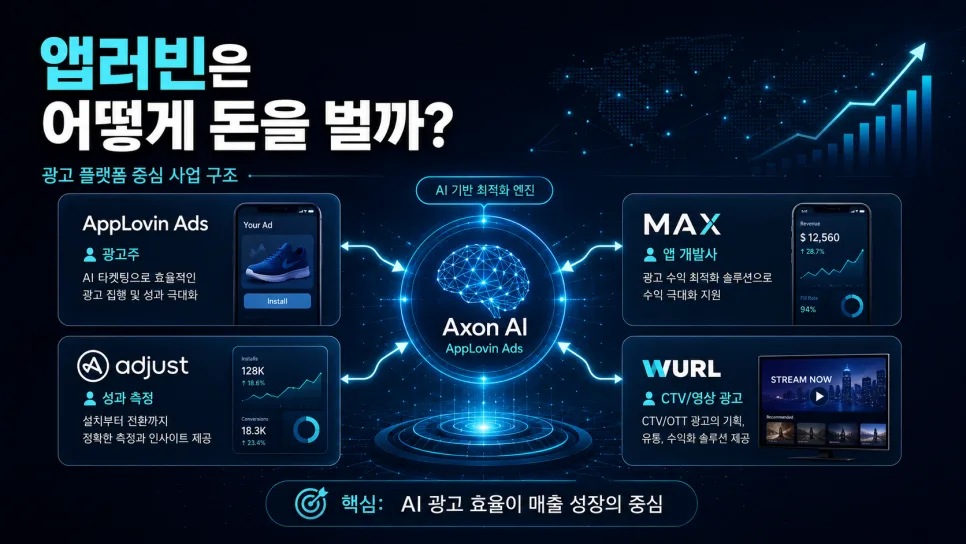
AppLovin currently operates as a single reportable segment, with four core services: AppLovin Ads, MAX, Adjust, and Wurl. Of those, AppLovin Ads is effectively responsible for the majority of revenue.
AppLovin Ads is a demand-side advertising platform where advertisers set goals like target ROAS or cost per purchaser, and the AI finds the right ad placements and users. When campaign performance improves, advertisers have a reason to spend more, and AppLovin’s revenue rises along with that spend.
MAX helps app developers sell their ad inventory through real-time auctions. Adjust provides ad measurement, user behavior analytics, and attribution tools. Wurl handles connected TV advertising technology.
One of the most important details here is ad efficiency. In Q2 2026, AppLovin Ads net revenue per install increased 58% year over year, while install volume fell 2%. That suggests the company isn’t just growing by pushing more ad impressions—it’s generating more revenue from the same traffic.
Key Takeaways From the Latest Earnings
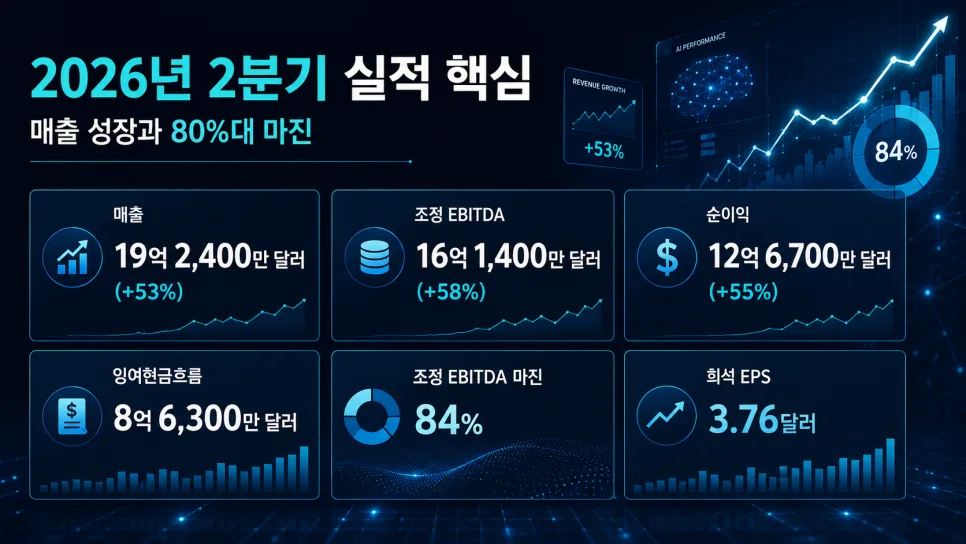
The Q2 2026 numbers were very strong.
• Revenue: $1.924 billion, up 53% year over year
• Net income: $1.267 billion, up 55% year over year
• Net income from continuing operations: $1.267 billion, up 64% year over year
• Adjusted EBITDA: $1.614 billion, up 58% year over year
• Adjusted EBITDA margin: about 84%
• Free cash flow: $863 million
• Diluted EPS: $3.76
The growth rate is impressive, but what stands out even more to me is the margin profile. If more than $1.6 billion of adjusted EBITDA is left over from $1.9 billion in revenue, that tells you incremental revenue is not bringing a proportional jump in costs.
First-half revenue also reached $3.766 billion, up 56% from a year earlier, while adjusted EBITDA rose 62% to $3.171 billion. So far, this doesn’t look like a one-quarter spike—it looks like growth and profitability are both continuing.
Geographically, revenue was also fairly balanced, with about $990 million from the United States and about $934 million from international markets. That means the business is not overly concentrated in a single country.
What’s Driving the Growth

First is better ad efficiency from Axon AI. The clearest number explaining AppLovin’s revenue growth is the increase in net revenue per install. Advertisers only keep raising budgets if they can get better results from the same spend, and right now the results suggest that’s happening.
Second is advertiser expansion. AppLovin is moving beyond its original strength in mobile game advertising into e-commerce and broader consumer brands. It now supports not just ROAS-based campaigns, but also cost-per-purchaser and lead-generation models, which opens the door to categories like insurance and home services.
Third is self-serve access. In the past, using AppLovin Ads required a more direct relationship with the company, but now ordinary businesses can sign up and launch campaigns themselves. According to the company, the platform reaches more than 1 billion daily active users.
Fourth is product expansion. In e-commerce, AppLovin has added Prospecting Campaign tools to find customers with no prior purchase history, as well as Discovery Campaign products aimed at people who have never interacted with the brand at all. That shows AppLovin is trying to expand from mobile app install ads into web-based purchase conversion advertising.
Competitive Position and Market Standing
The biggest thing that sets AppLovin apart from other ad platforms is that it doesn’t rely on just one piece of ad inventory—it connects the broader advertising ecosystem.
On the advertiser side, there’s AppLovin Ads. On the publisher side, there’s MAX. And it also owns Adjust for performance measurement. Because it can connect ad buying, ad selling, and measurement in one system, there’s a real chance Axon’s predictive accuracy improves as more data accumulates.
That said, the competition is serious. The digital ad market is dominated by giants like Google and Meta, and the performance advertising space is crowded with other ad tech companies.
In the end, if AppLovin wants to keep taking market share, it can’t just market itself as an AI company—it has to keep proving that advertisers actually get better ROAS. The current revenue growth and higher net revenue per install are encouraging, but those will remain the most important metrics to watch.
Cash Flow and Shareholder Returns
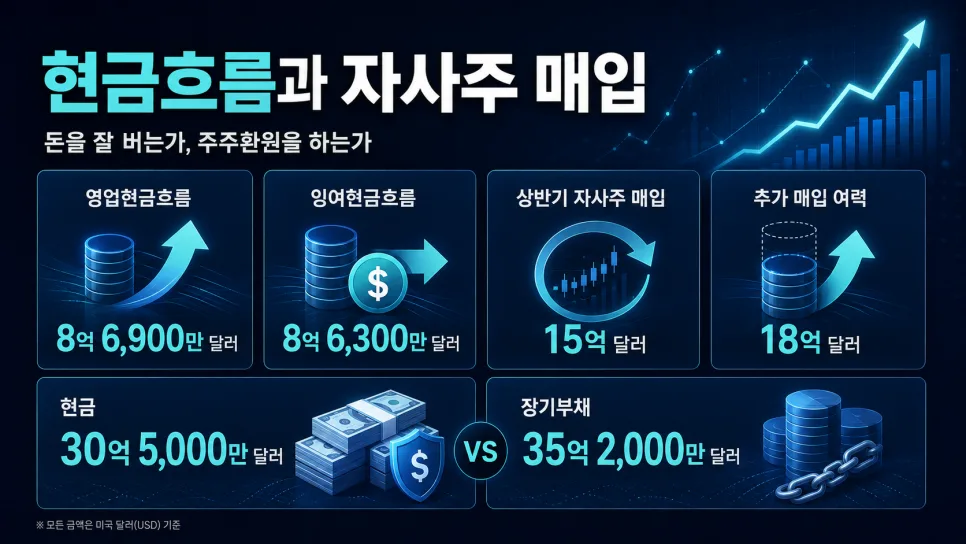
One of the most appealing parts of the AppLovin story is cash flow. In Q2 2026, operating cash flow was $869 million and free cash flow was $863 million.
That means a large share of reported profit is turning into real cash. A lot of software and AI growth companies grow revenue quickly without generating much cash, but AppLovin looks meaningfully different on that front.
The company has also been aggressive with share repurchases. In the first half of 2026, it bought back and retired about 3.3 million Class A shares for $1.5 billion, and as of the end of June, it still had roughly $1.8 billion remaining under its buyback authorization.
On the other hand, long-term debt stood at about $3.52 billion. Still, with roughly $3.05 billion in cash and cash equivalents at the same point—and strong cash generation—the debt does not look overwhelming based on the current numbers.
Stock Price and Valuation
As of August 28, 2026, APP closed at $317.76. Its market cap was about $106.3 billion, with a trailing 12-month P/E of around 24 and a forward P/E of roughly 17.
What’s interesting is the gap between growth and valuation. Q2 revenue grew 53%, and net income from continuing operations rose 64%, yet the stock remains far below its 52-week high of $745.61.
Based on the numbers alone, you could argue that a lot of the extreme growth-stock premium AppLovin once enjoyed has already come out of the stock.
That said, APP is a high-beta name and the share price is extremely volatile. Rather than deciding it’s cheap based on one strong quarter and a lower P/E, I think it matters more to ask how much profit the company can sustain once growth normalizes.
To me, the biggest valuation question is whether this 80%+ adjusted EBITDA margin is structurally sustainable.
Pros and Cons
Pros
• Revenue growth remained very strong, with Q2 2026 up 53%.
• Better Axon AI performance is driving a sharp increase in net revenue per install, and that improvement in ad efficiency is translating into results.
• Adjusted EBITDA margin of about 84% shows the powerful operating leverage of the platform model.
• Free cash flow generation is strong, and the company is executing large-scale share buybacks.
• There is significant room to expand from mobile game ads into e-commerce and the broader performance advertising market.
Cons
• AppLovin still has to compete long term with global advertising platforms including Google and Meta.
• Because ad performance depends heavily on the competitiveness of the Axon algorithm, growth could slow quickly if that technology edge weakens.
• Tighter privacy and ad-tracking regulations could affect the business model.
• Reuters reported that a U.S. Securities and Exchange Commission (SEC) investigation related to AppLovin was still ongoing in 2026. There has been no formal finding of wrongdoing or indictment, but it remains a source of uncertainty.
• The stock is highly volatile, so even strong earnings may not protect the multiple if growth expectations start to cool.
What I’ll Watch in the Next Earnings Report
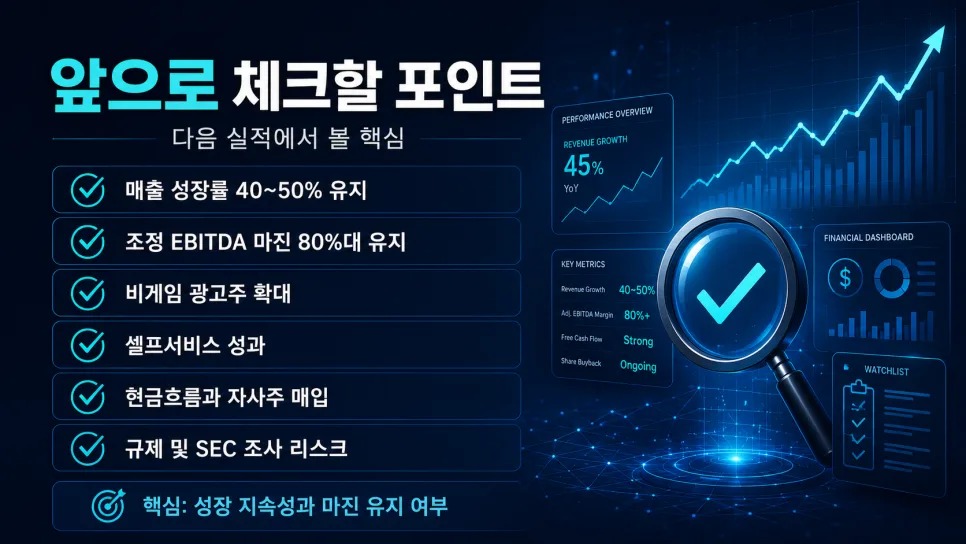
AppLovin guided for Q3 2026 revenue of $2.055 billion to $2.085 billion. Adjusted EBITDA guidance was $1.710 billion to $1.740 billion, implying a margin of about 83%.
In the next report, I’ll be looking at more than whether the company simply beats estimates.
-
Whether revenue growth can stay in the 40% to 50% range
-
Whether adjusted EBITDA margin can remain above 80%
-
Whether AppLovin Ads keeps improving ad efficiency
-
How quickly spending from non-gaming advertisers grows
-
Whether new advertiser sign-ups after the self-serve launch actually convert into revenue
-
Whether free cash flow and share repurchases remain strong
Going forward, it may matter less how dominant AppLovin is in mobile game advertising and more how much general business ad spend it can pull away from Meta and Google.
Final Thoughts
The most impressive thing to me after revisiting AppLovin wasn’t just the speed of revenue growth. Revenue rose 53%, adjusted EBITDA margin reached about 84%, and free cash flow topped $800 million in a single quarter. Those are not just growth-stock numbers—they look more like the numbers of a company that is already a serious cash machine.
Another major shift is the company’s decision to separate from the game business and focus on the advertising platform. If you still evaluate AppLovin the way you would have during its mobile gaming era, you could easily miss the most important change in the story.
That said, I wouldn’t automatically call it cheap just because current results are strong. A huge part of AppLovin’s value depends on whether Axon can continue delivering better ad efficiency than competing platforms. On top of that, there are still open questions around advertising and privacy regulation, as well as the SEC investigation.
Even so, there are not many U.S. growth stocks in 2026 showing this kind of strength across revenue growth, margins, and cash flow at the same time. If you’re looking at AppLovin stock, I think it makes more sense to focus less on how far the share price has fallen from its peak and more on how long the ad platform can sustain its growth rate and 80%+ margins.
Personally, rather than trying to call the short-term stock move, I’d put this in the category of names worth watching over the next two to three quarters, especially to see whether non-gaming advertiser expansion and margin durability hold up. As always, any investment decision should match your own time horizon and risk tolerance.
Sources
• AppLovin Corporation, Q2 2026 earnings release
• AppLovin Corporation, Form 10-Q for the quarter ended June 30, 2026
• AppLovin official blog, announcement of full advertiser access to AppLovin Ads, June 22, 2026
• AppLovin official materials on Discovery Campaigns and Axon AI
• Reuters, report on the SEC investigation related to AppLovin
• Stock price and valuation data based on S&P Global Market Intelligence, as of August 28, 2026
#applovin #AppLovin #APP #applovinstock #usstocks #stockanalysis #aistocks #aiadvertising #adplatform #AxonAI #growthstocks #usgrowthstocks #globalstocks #investing #stockresearch