

If there’s one company that immediately comes to mind in surgical robotics, it’s Intuitive Surgical. Built around the flagship da Vinci surgical system, the company has already established a massive installed base in hospitals worldwide, and procedure volume continues to climb. For anyone researching Intuitive Surgical stock, that installed base is the real story.
In Q2 2026, revenue came in at $2.892 billion, up 19% year over year. da Vinci procedures rose 15% to about 889,000, while Ion procedures—used for lung biopsies and similar cases—jumped 36% to roughly 47,900.
What matters most is that this is not a one-and-done hardware business. Every time a surgery is performed, instruments and accessories are used, and every installed system also generates service revenue. The more robots placed in hospitals and the more procedures performed, the stronger the recurring revenue engine becomes.
The flip side is that the market already knows this is a high-quality business. As of August 28, 2026, ISRG closed at $372.60, and its forward P/E was around 33x. The stock is well off its 52-week high, but compared with traditional medical device companies, it still trades at a meaningful premium.
How Intuitive Surgical Makes Money
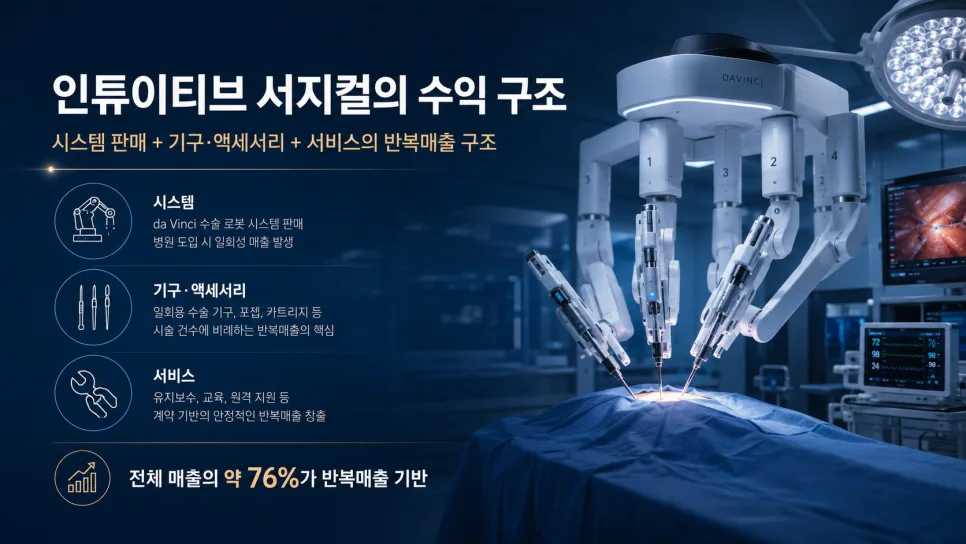
Intuitive Surgical’s business can be broken into three core segments.
First is system sales, including platforms like da Vinci and Ion. Revenue is recognized when hospitals buy a new surgical robot or bring one in through a lease structure.
Second is Instruments and Accessories. This is the revenue generated from the tools and accessories used during actual procedures.
Third is Service. That includes maintenance and support for surgical robots already installed in hospitals.
In Q2 2026, Instruments and Accessories revenue was $1.735 billion, system revenue was $685 million, and service revenue was $472 million.
Instruments, accessories, and service alone totaled about $2.207 billion, or roughly 76% of total revenue.
In other words, this is not a company whose results depend only on selling new robots. The core of the model is that installed systems keep generating fresh revenue over time.
Q2 2026 Results Were Very Strong
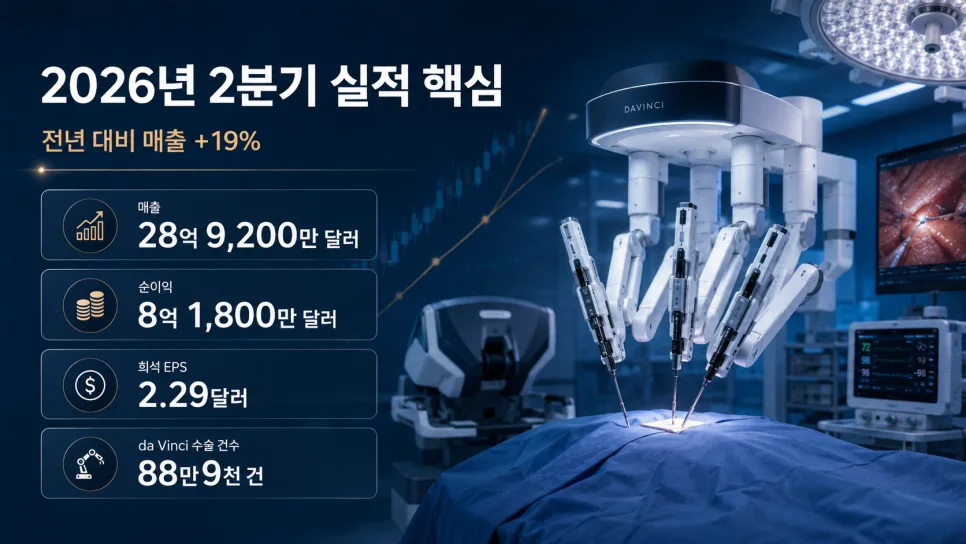
Q2 2026 revenue reached $2.892 billion, up 19% from $2.440 billion in the same quarter last year.
GAAP operating income was $972 million, up about 31% from $743 million a year earlier.
GAAP net income attributable to Intuitive Surgical was $818 million. That was roughly 24% growth versus $658 million last year.
Diluted EPS increased from $1.81 to $2.29.
On a non-GAAP basis, net income rose to $1.0 billion, diluted EPS came in at $2.80, and non-GAAP gross margin reached 70.0%.
That said, this quarter included a $28 million after-tax benefit tied to refunds of previously paid tariffs. That equals about $0.08 in diluted EPS, so it’s worth adjusting for when evaluating the underlying earnings power.
As Procedure Volume Grows, Recurring Revenue Grows With It
From a long-term investing perspective, I think actual procedure volume matters more than new robot sales when evaluating Intuitive Surgical stock.
In Q2 2026, da Vinci procedures increased 15% year over year to about 889,000.
Ion procedures rose 36% to roughly 47,900.
As procedure volume rises, usage of instruments and accessories naturally rises too. In fact, Q2 Instruments and Accessories revenue increased 18% year over year to $1.735 billion.
Once the company installs a system in a hospital, it effectively secures a long runway for revenue based on the surgeries that hospital may perform in the future.
From the hospital’s perspective, adopting a surgical robot also leads to accumulated staff training, workflow development, and hands-on operating experience.
That installed base and clinician familiarity can become a real barrier to entry—something new competitors may struggle to overcome even if they offer lower equipment prices.
Da Vinci 5 Is the Next Major Growth Driver
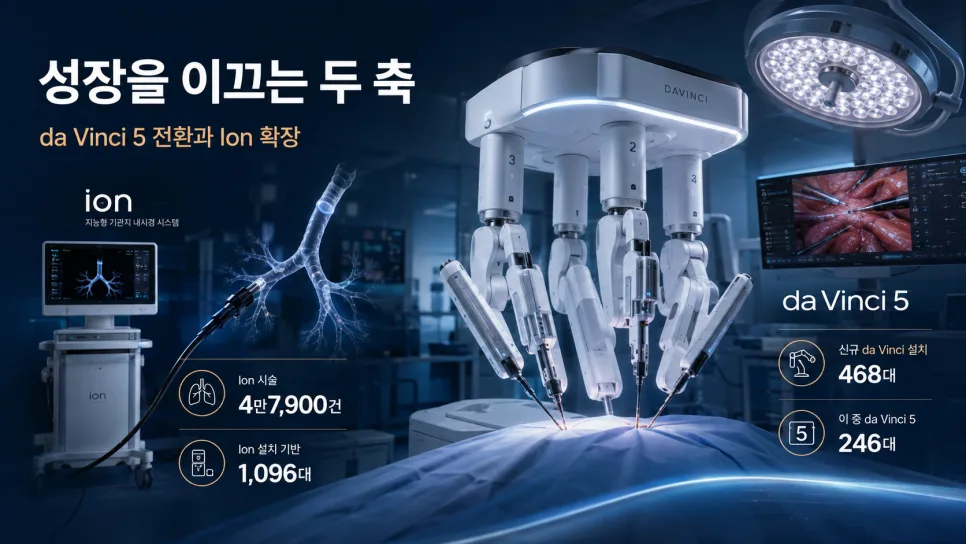
The most important product right now is the next-generation da Vinci 5 system.
In Q2 2026, Intuitive Surgical placed 468 da Vinci systems, up 18% from 395 in the same period last year.
Of those, 246 were da Vinci 5 systems, a big increase from 180 a year earlier.
That matters because more than half of all new da Vinci placements were already da Vinci 5.
As of the end of June, the global da Vinci installed base reached 11,710 systems, up 12% from 10,488 a year earlier.
That creates room not only for new system sales, but also for an upgrade cycle as existing hospitals replace older machines with next-generation platforms.
Also worth noting: of the 468 new da Vinci placements in Q2, 254 were operating leases. Of those, 131 were usage-based leases.
That may reduce upfront revenue recognition compared with an outright sale, but it could actually strengthen the long-term recurring revenue model tied to procedure volume.
Ion Is Also Growing Quickly as a Second Platform
da Vinci is clearly the core business, but Ion’s growth is getting harder to ignore.
Ion is a robotic-assisted bronchoscopy platform designed to reach lesions deep inside the lung and perform biopsies.
In Q2 2026, Ion procedures rose 36% year over year to about 47,900.
At the end of June, the Ion installed base stood at 1,096 systems, up 21% from 905 a year earlier.
New Ion placements totaled 55 in the second quarter.
It’s still much smaller than da Vinci, but it matters because it shows Intuitive is expanding beyond surgical robotics alone and into diagnostic and minimally invasive treatment platforms.
Over time, if Ion follows a path similar to da Vinci—with a larger installed base, rising procedure volume, and growing instruments and service revenue—it could become a meaningful second recurring revenue pillar.
Beyond da Vinci and Ion, the company is also expanding its digital solutions. Long term, this looks like a strategy to build an ecosystem around not just robotic hardware, but also surgical data and software generated throughout the procedure workflow.
Cash Position and Balance Sheet Are Very Solid
As of the end of June 2026, Intuitive Surgical held about $8.63 billion in cash, cash equivalents, and investments.
That was up roughly $650 million from the prior quarter.
Total debt at the same point was about $2.58 billion. With cash and investments far exceeding total debt, the balance sheet looks very stable.
This is a growth company, but not one that needs to keep raising outside capital. It can fund R&D and manufacturing expansion through its own operating cash flow.
The company is also continuing to increase R&D spending. In Q2 2026, research and development expense was about $371 million, up from roughly $313 million a year earlier.
To maintain its position in surgical robotics, Intuitive needs to keep investing in next-generation robots, instruments, software, and diagnostic platforms, so higher R&D spending looks like a necessary long-term cost rather than a red flag.
Stock Price, Valuation, and Shareholder Returns
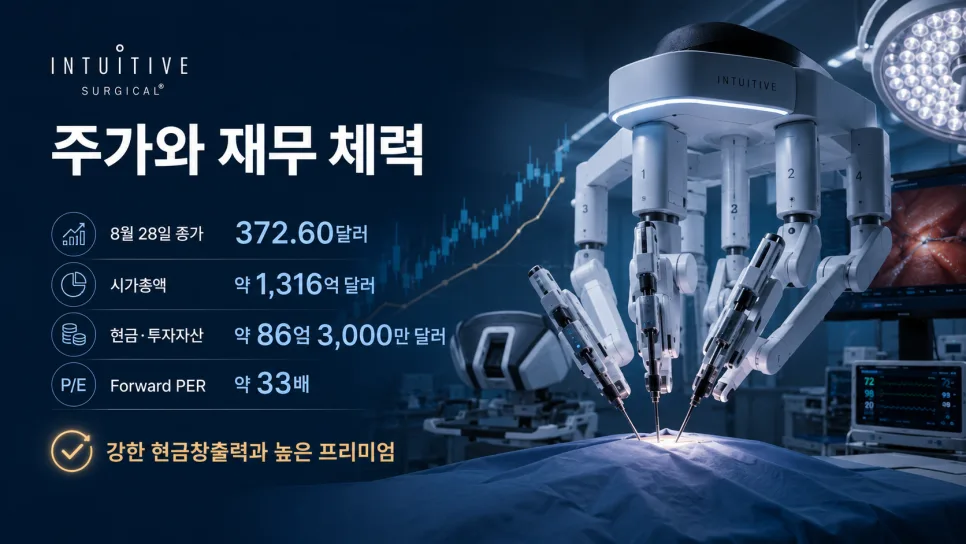
As of August 28, 2026, ISRG closed at $372.60.
The 52-week range is $328.57 to $603.88. That puts the stock about 38% below its high.
The current market cap is about $131.6 billion.
Over the last 12 months, revenue was about $11.03 billion and net income was about $3.14 billion.
TTM P/E is roughly 42.7x, and forward P/E is around 33x.
Even after the pullback from prior highs, it’s hard to call the valuation cheap in absolute terms.
The market is still pricing in the expectation that Intuitive can sustain double-digit procedure growth and strong profitability for a long time.
The company does not pay a dividend.
Instead, it is buying back stock. In Q2 2026, it repurchased 900,000 shares—not 90,000—for $380 million.
With ample cash on hand and the share count down over the past year, that’s a positive sign from a capital return perspective.
Pros and Cons
Pros
• da Vinci procedure volume grew 15%, and the recurring revenue base continues to expand after each system installation.
• About 76% of total revenue comes from instruments, accessories, and service, so the business is not dependent only on new system sales.
• The da Vinci installed base has reached 11,710 systems, creating a powerful global network effect.
• New da Vinci 5 placements rose to 246, showing that the next-generation upgrade cycle is underway.
• Ion procedure volume grew 36%, and the company’s newer minimally invasive platform is scaling quickly.
• With about $8.6 billion in cash and investments, the company can fund R&D and expansion internally.
Cons
• Forward P/E is still around 33x, which remains a high valuation for a medical device company.
• If hospital capital spending weakens or interest rates stay high, adoption timelines for new systems could slip.
• As a medical device company, Intuitive is highly exposed to regulatory approvals and product safety issues, including oversight from the U.S. Food and Drug Administration (FDA) and other regulators worldwide.
• As competition in surgical robotics expands, long-term pressure on pricing and market share could emerge.
• Tariffs and supply chain costs can directly affect gross margin.
• High expectations are already reflected in the stock price, so if procedure growth slows, the valuation reset could be significant.
What to Watch in the Next Earnings Report
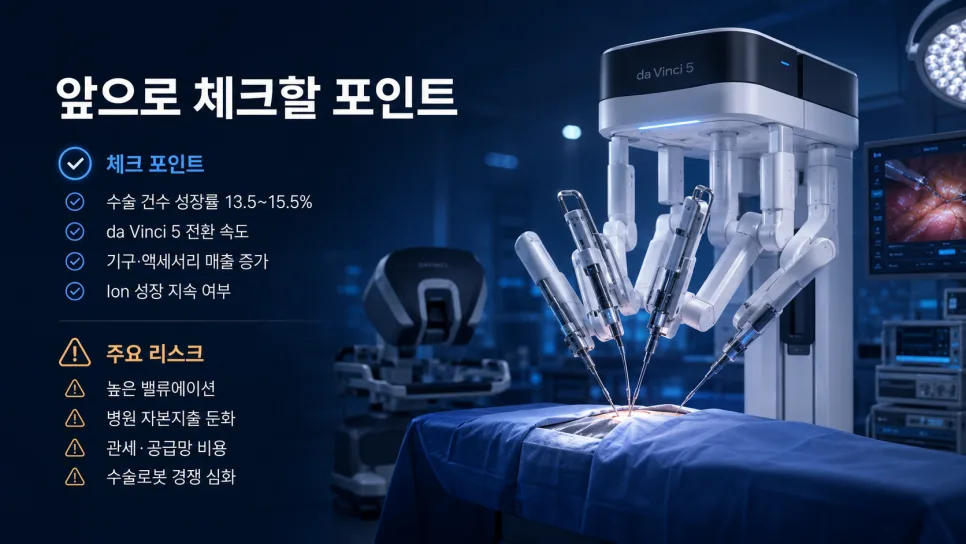
The company is guiding for full-year 2026 da Vinci procedure growth of 13.5% to 15.5%.
Management currently expects results to land around the middle of that range.
Full-year 2026 non-GAAP gross margin is projected at 68% to 69%. That outlook includes an approximately 1 percentage point negative impact from tariffs.
Here’s what I’ll be watching going forward.
-
Whether da Vinci procedure growth holds in the 14% to 15% range
-
Whether Ion procedure growth continues above 30%
-
Whether the da Vinci 5 mix keeps rising
-
Whether the total da Vinci installed base moves above 12,000 systems
-
Whether Instruments and Accessories revenue keeps growing alongside procedure volume
-
Whether the company maintains its 68% to 69% non-GAAP gross margin outlook
-
Whether tariff pressure on actual margins comes in worse than expected
-
How the mix of operating leases and usage-based leases changes over time
Personally, I’m less interested in new robot sales alone than in the combination of procedure growth and instruments-and-accessories revenue growth.
In the long run, what will determine Intuitive Surgical’s value is not simply how many robots it sells, but how many procedures are repeatedly performed across its installed base of more than 10,000 systems.
Final Take
Looking at Intuitive Surgical, it’s not hard to see why the company commands such a premium in the surgical robotics industry.
Q2 revenue grew 19%, net income rose about 24%, and da Vinci procedures increased 15%. Even at its current scale, the company is still delivering double-digit growth.
More importantly, the business model is excellent. After a robot is placed, every surgery drives instruments and accessories revenue, while the installed system also generates service revenue.
In Q2, those instruments, accessories, and service streams accounted for about 76% of total revenue. As the installed base grows, the recurring revenue foundation grows with it.
The da Vinci 5 transition is also entering an important phase. Of 468 new placements, 246 were da Vinci 5 systems. If existing hospitals begin replacing older machines more aggressively, that could support a fresh cycle of system revenue.
Ion is still smaller, but it’s moving in the right direction too. Procedure volume rose 36%, and the installed base grew 21%. That’s encouraging because it suggests the company is building a real second platform beyond da Vinci.
On the other hand, it’s still hard to call the stock cheap. Shares have fallen from the $600 range to $372.60, but the forward P/E is still around 33x.
A great company does not automatically mean a great entry price.
That’s why, when I look at Intuitive Surgical stock, I focus less on how far the share price has fallen from its peak and more on whether da Vinci procedure growth stays in the mid-teens, whether the da Vinci 5 transition continues, and whether the recurring revenue mix holds up.
If those three factors remain intact, Intuitive Surgical’s long-term competitive position is unlikely to weaken much. But if procedure growth slows sharply, the current valuation may need to be reassessed.
Sources
• Intuitive Surgical Q2 2026 earnings release
• Intuitive Surgical Q2 2026 Form 10-Q
• Intuitive Surgical Q2 2026 Investor Presentation
• Intuitive Surgical Investor Relations materials
• StockAnalysis market data, as of August 28, 2026
#intuitivesurgical #isrg #intuitivesurgicalstock #usstocks #stockanalysis #surgicalrobotics #davincirobot #davinci5 #medicalrobotics #medicaldevicestocks #ion #healthcarestocks #growthstocks #nasdaq #globalstocks #investing #stockresearch