

It’s easy to assume GPUs are the biggest bottleneck in the AI era, but now the electricity needed to run those GPUs 24/7 is becoming just as critical. As more data centers come online, the need for large-scale, reliable power is growing fast—and that’s exactly why Constellation Energy, one of the biggest nuclear operators in the United States, keeps coming up in the conversation around AI data center power.
Constellation Energy already had a major edge as the largest nuclear power operator in the U.S., but after completing its Calpine acquisition in January 2026, it became something much bigger: a broad power generation platform with nuclear, natural gas, and geothermal assets. On top of that, the company has signed long-term power agreements with Big Tech names like Microsoft and Meta, turning AI data center power demand into visible, long-duration revenue.
That said, this isn’t a one-sided bull story. After the Calpine deal, debt increased sharply, and CEG stock already trades with a meaningful premium as one of the market’s best-known AI power names. So instead of looking at it as just another nuclear beneficiary, it makes more sense to focus on the actual earnings, contract structure, and execution from here.
Why Constellation Energy Deserves a Look Now
The biggest reason to watch Constellation Energy right now is that the U.S. power demand backdrop is changing. For a long time, electricity consumption in the United States was relatively flat, but that’s shifting as AI data centers, semiconductor fabs, and advanced manufacturing facilities continue to expand.
Data centers are hard to run on power sources like solar and wind alone, because output changes depending on the time of day and weather conditions. These facilities need massive amounts of electricity around the clock, which makes high-capacity, always-on generation like nuclear much more valuable.
Constellation is well positioned for that environment because it already owns a large fleet of operating nuclear assets. From an investment perspective, that matters a lot: extending the life of existing reactors—or even restarting previously retired plants—can be far more realistic in both time and cost than building entirely new nuclear capacity from scratch.
From Nuclear Utility to Full-Scale Power Platform
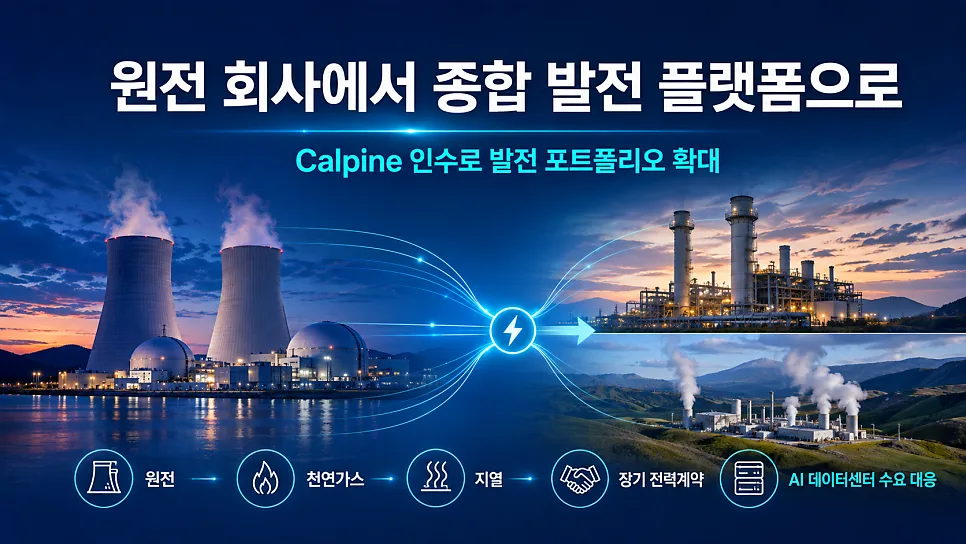
If you still think of Constellation in 2026 as the same old nuclear company, you’re probably missing the biggest shift in the story. The company completed its Calpine acquisition in January 2026, expanding from one of the largest generators in the U.S. into the country’s largest power producer by scale.
Calpine’s strength has long been in natural gas and geothermal generation. That means Constellation no longer relies only on nuclear—it now has a broader generation mix and more flexibility to serve power demand across different regions and time periods.
The Calpine acquisition was valued at about $21.8 billion and was completed using roughly 50 million shares of Constellation stock plus cash and other consideration. This wasn’t a small asset purchase—it was a transformational deal that changed the size and shape of the company.
That matters because AI data center power demand is not something nuclear alone can solve in every situation. For customers that want reliable 24/7 electricity, Constellation can now offer a more complete package that combines nuclear, gas, geothermal, and power procurement capabilities. Over time, that could become a real competitive advantage.
How Were Constellation Energy’s Q2 2026 Results?
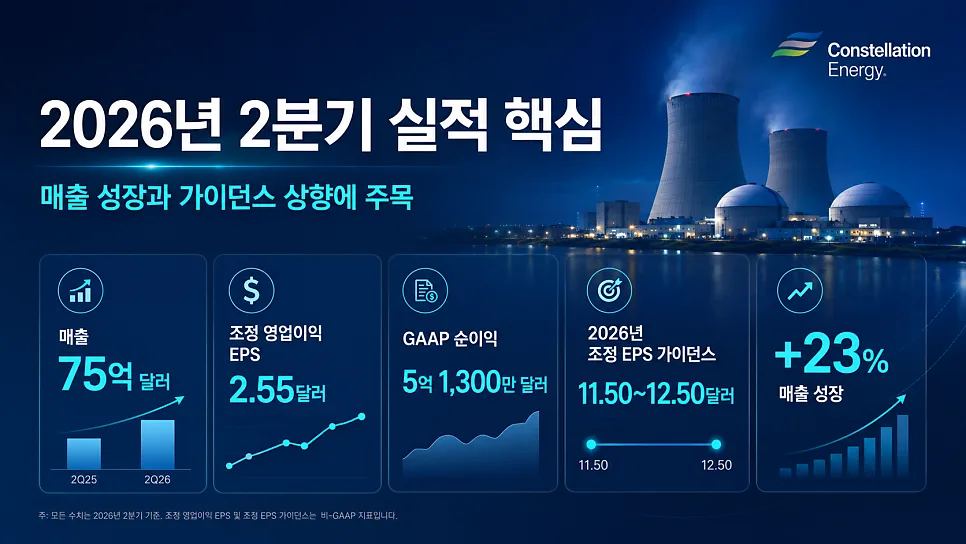
In the second quarter of 2026, Constellation reported revenue of about $7.5 billion, up 23% from roughly $6.1 billion a year earlier. First-half revenue reached about $18.6 billion, compared with around $12.9 billion in the same period last year, an increase of 44.5%.
One of the biggest reasons for that jump was the inclusion of Calpine’s results. So it would be misleading to read this as the legacy business suddenly growing more than 40% on its own—the acquisition effect needs to be separated out.
On a GAAP basis, second-quarter net income attributable to common shareholders came in at about $513 million, down from $839 million a year earlier. But adjusted operating earnings per share, which management uses as a core profitability metric, rose from $1.91 to $2.55.
Based on that performance, the company raised its full-year 2026 adjusted operating EPS guidance to $11.50 to $12.50. The Calpine contribution and supportive power market conditions helped results, while nuclear outage time tied to maintenance created some offsetting pressure.
Why Microsoft and Meta Are Turning to Nuclear Power
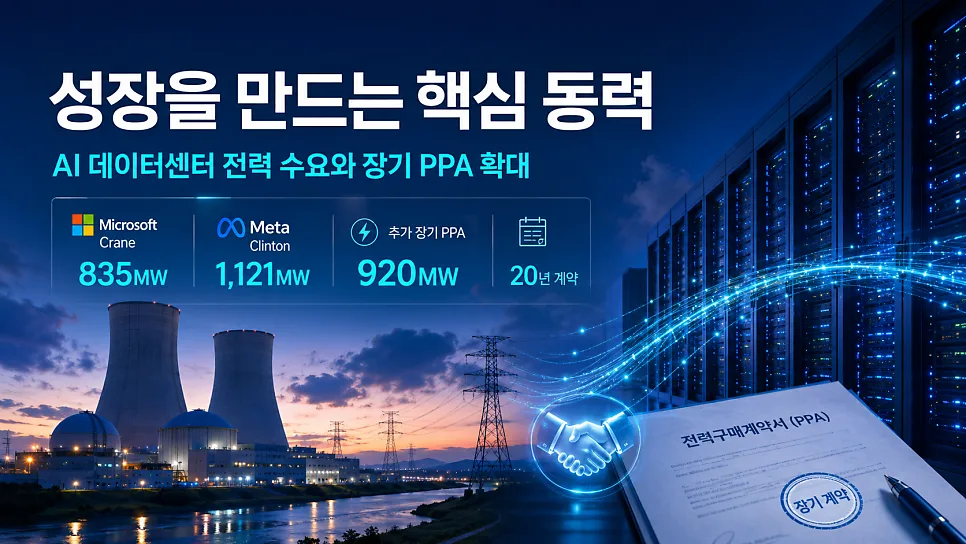
You really can’t talk about the Constellation investment case without mentioning the Microsoft and Meta deals. Constellation signed a major agreement with Microsoft tied to restarting a previously closed nuclear plant, and it also reached a separate deal with Meta to support the long-term operation of the currently running Clinton nuclear plant.
The Microsoft agreement is a 20-year power purchase agreement. Constellation plans to restart the plant formerly known as Three Mile Island Unit 1 under the new name Crane Clean Energy Center, supplying about 835 MW of carbon-free electricity.
Meta also signed a 20-year agreement tied to the Clinton Clean Energy Center. The contract covers 1,121 MW of carbon-free nuclear power and is expected to begin in June 2027. The company also plans to increase the plant’s output by about 30 MW.
On top of that, Constellation said in Q2 2026 that it signed an additional 920 MW of long-term power purchase agreements with investment-grade customers. The key takeaway is that the push by Big Tech and large corporations to lock in reliable long-term electricity is not a one-off headline—it’s continuing to show up in real contracts.
Why the Crane Nuclear Restart Matters
The Crane Clean Energy Center is one of the clearest symbols of Constellation’s growth strategy. This plant was shut down in 2019 because of economic pressure, but rising AI data center power demand has made it financially relevant again.
In Q2 2026, the restart effort also moved forward on the regulatory side. The Federal Energy Regulatory Commission allowed the plant’s existing grid interconnection rights to be transferred to Crane, and the Nuclear Regulatory Commission approved changes related to nuclear fuel licensing.
The company is currently targeting a 2027 restart. If it succeeds, about 835 MW of power will return to the market, and the long-term Microsoft contract will begin to translate into meaningful operating results.
More importantly, if this case works, it could raise the economic value of other existing nuclear assets as well—whether through life extensions or uprates. So this is bigger than one plant’s earnings contribution; it could lead to a broader re-rating of U.S. nuclear assets.
The Opportunity—and Burden—Created by the Calpine Deal
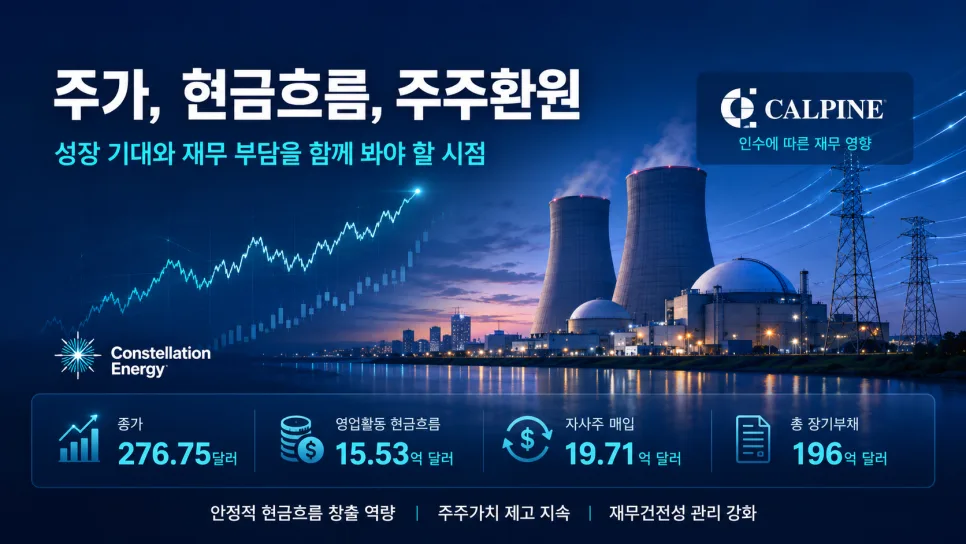
The Calpine acquisition increased Constellation’s growth potential, but it also added real financial pressure. As of the end of June 2026, total long-term debt stood at about $19.6 billion, up sharply from roughly $7.4 billion at the end of 2025.
Of that, about $12.6 billion came from debt assumed in the Calpine transaction itself. So over the next few years, investors will need to watch not just synergy targets, but also debt management and integration costs.
On the other hand, the asset base Constellation gained is substantial. Combining its nuclear fleet with Calpine’s natural gas and geothermal plants significantly improved both generation diversity and geographic diversification, while also increasing the company’s ability to sign large long-term power contracts with major corporate customers.
Operating cash flow for the first half of 2026 was about $1.553 billion. During the same period, the company spent about $1.971 billion on share repurchases. Since Constellation is trying to balance growth investment, acquisition integration, debt management, and shareholder returns all at once, capital allocation will be an important area to watch.
Current Stock Price and Valuation
As of August 28, 2026, CEG closed at $276.75. Its market capitalization was about $99 billion, and based on recent market data, the stock was trading at roughly 27x trailing twelve-month earnings and about 23x forward earnings.
Since the 52-week high was above $400, the stock has already pulled back meaningfully from its peak. But that doesn’t automatically make it cheap in the way investors might think about a traditional utility.
The reason the market gives CEG a higher valuation is that investors are not treating it like a standard utility. They’re pricing in AI data center power demand, rising nuclear asset values, and growth from expanding long-term PPAs.
On the flip side, if expectations for AI power demand cool off or long-term power pricing becomes less attractive, the premium CEG enjoys today could shrink. To justify a forward P/E above 20, the company still needs to keep delivering real EPS growth.
The dividend is currently $0.4265 per share quarterly, so the yield itself is not especially high. CEG looks more like a stock for investors focused on earnings growth and rising power asset values than a classic income play.
Pros and Cons
Pros
• Constellation has the largest nuclear operating base in the United States, giving it direct exposure to rising demand for reliable, carbon-free 24/7 electricity.
• The company is converting AI data center power demand into real contracts through long-term power purchase agreements with major customers including Microsoft and Meta.
• The Calpine acquisition added natural gas and geothermal generation, significantly improving both portfolio diversification and regional flexibility.
• If the Crane restart and nuclear uprate projects succeed, Constellation could add power capacity faster than building entirely new plants.
• The company raised its full-year 2026 adjusted EPS guidance, suggesting that earnings growth expectations remain intact even after the acquisition.
Cons
• The Calpine acquisition sharply increased total long-term debt, raising future interest expense and balance sheet risk.
• Nuclear plants can create earnings volatility when maintenance issues or planned and unplanned outages occur.
• Nuclear restarts and life extensions depend on regulatory approvals and the political environment, which means delays are always possible.
• Current valuation already reflects a meaningful amount of optimism around AI data centers and power shortages.
• If electricity prices weaken or data center expansion slows, expected returns from these power assets could come down.
What to Watch in Future Results
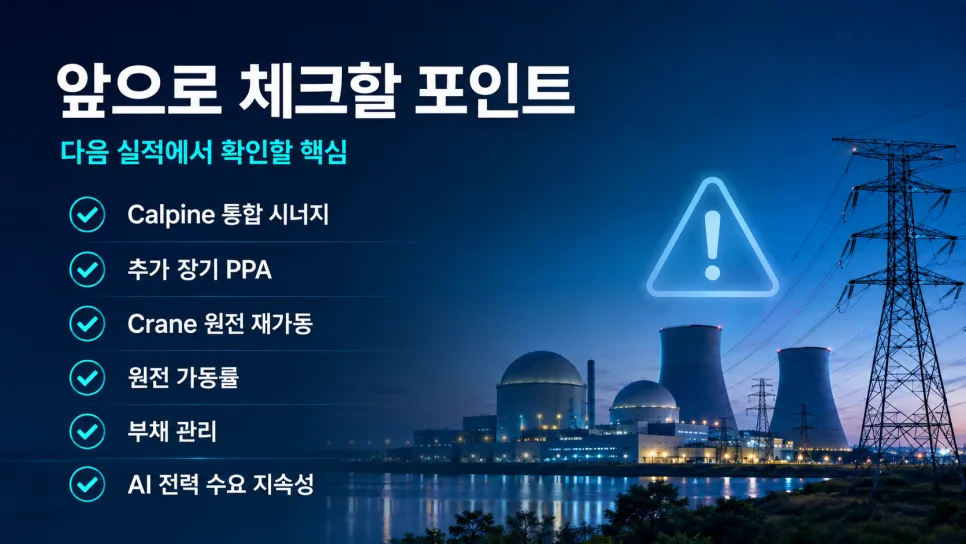
If you plan to keep tracking CEG, it’s more useful to focus on indicators that actually translate into earnings rather than just reacting to general nuclear headlines.
-
Whether the company actually delivers on its 2026 adjusted EPS guidance of $11.50 to $12.50
-
Whether cost savings and revenue synergies show up as planned after the Calpine integration
-
Whether additional data center and corporate PPA deals continue after Microsoft and Meta
-
Whether Crane Clean Energy Center stays on track for its planned 2027 restart
-
Whether nuclear capacity factors stabilize and unplanned maintenance losses come down
-
How management handles the roughly $19.6 billion long-term debt load after the acquisition
Going forward, it will be especially important to watch how many megawatts of new power contracts Constellation signs and how long those contracts run. If long-term PPAs keep building, the company can reduce its exposure to short-term power price swings while making future cash flow more predictable.
Is the AI Power Shortage a Real Long-Term Cycle?
Ultimately, the most important question for any CEG investor is whether the AI data center power shortage is a multi-year structural cycle. If data center construction plans are actually carried out and U.S. manufacturing reshoring continues, the economic value of existing generation assets could end up much higher than in the past.
Nuclear is especially important here because new reactors are extremely difficult to build quickly. That’s exactly why companies that already own operating nuclear plants have an advantage. For Constellation, even facilities that once looked uneconomic can become profitable again through new long-term power contracts.
Still, it would be risky to invest based only on the broad idea of a power shortage. There are too many variables: delays in data center projects, grid interconnection bottlenecks, political and regulatory changes, natural gas prices, and shifts in power market structure.
That’s why I see CEG less as a simple AI theme stock and more as a way to track whether structural changes in the U.S. electricity market are turning into real long-term contracts and higher power asset values.
Final Thoughts
Looking at Constellation Energy makes one thing very clear: AI is not an industry that only benefits semiconductor companies. As AI server capacity expands, the value of physical infrastructure—power generation, transmission, and cooling—rises with it.
CEG’s biggest advantage is that it already owns large-scale nuclear assets that can generate power right now. Microsoft’s 835 MW Crane agreement, Meta’s 1,121 MW Clinton agreement, and the additional 920 MW of long-term PPAs signed in Q2 2026 all support the same idea: the race to secure electricity is turning into real contracts. That is exactly why AI data center power has become such an important part of the CEG story.
The Calpine acquisition is also genuinely interesting over the long run. By evolving from a nuclear-focused company into a broader power platform that includes natural gas and geothermal, Constellation now has far more ways to respond to rising U.S. electricity demand.
That said, I don’t see CEG as an easy stock to own at any price. Total long-term debt has climbed to about $19.6 billion after the Calpine acquisition, and a forward P/E above 20 already bakes in a lot of growth. If results come in even a little below expectations, the stock could stay volatile.
Even so, if you want stock exposure to AI data center power, CEG is still a company worth following closely. This is not just a vague nuclear theme—it’s a business with real plants, real long-term contracts, and real generating capacity.
From here, I think it makes more sense to watch whether the Calpine integration, Crane restart, long-term PPA expansion, and debt reduction all progress as planned rather than trying to guess how high the stock can go. As always, any investment decision should match your own time horizon and risk tolerance.
Sources
• Constellation Energy, Q2 2026 earnings release
• Constellation Energy, Q2 2026 Form 10-Q
• Constellation Energy, announcement of completed Calpine acquisition
• Constellation Energy, Microsoft Crane Clean Energy Center long-term power purchase agreement materials
• Constellation Energy, Meta Clinton Clean Energy Center long-term power purchase agreement materials
• Constellation Energy, Q2 2026 Earnings Presentation
• Market price and valuation data, as of August 28, 2026
#constellationenergy #CEG #cegstock #usstocks #stockanalysis #nuclearstocks #nuclearenergy #aidatacenterpower #datacenterpower #usnuclear #Calpine #Microsoft #Meta #utilitystocks #growthstocks #globalinvesting #investingeducation #usstocksinvesting