

SoFi was once best known as a fintech company focused on student loan refinancing. Today, it’s evolving into a full-scale digital financial company that offers deposits, personal loans, mortgages, investing, credit cards, crypto, insurance, and even enterprise fintech services on a single platform.
In its Q2 2026 results, that transformation showed up clearly in the numbers. GAAP net revenue came in at $1.219 billion, up 43% year over year, while net income rose 61% to $157 million.
Membership climbed 35% to 15.8 million, and total products reached 24.4 million. Just as important, SoFi’s cross-sell engine is getting stronger fast, with more members using multiple products across the ecosystem.
As of August 31, 2026, SOFI closed at $17.88. The stock is well off its highs, but the bigger story is that SoFi is no longer being judged as a money-losing fintech. It’s increasingly being valued as a financial platform with growing profits and cash flow.
How SoFi Technologies Makes Money
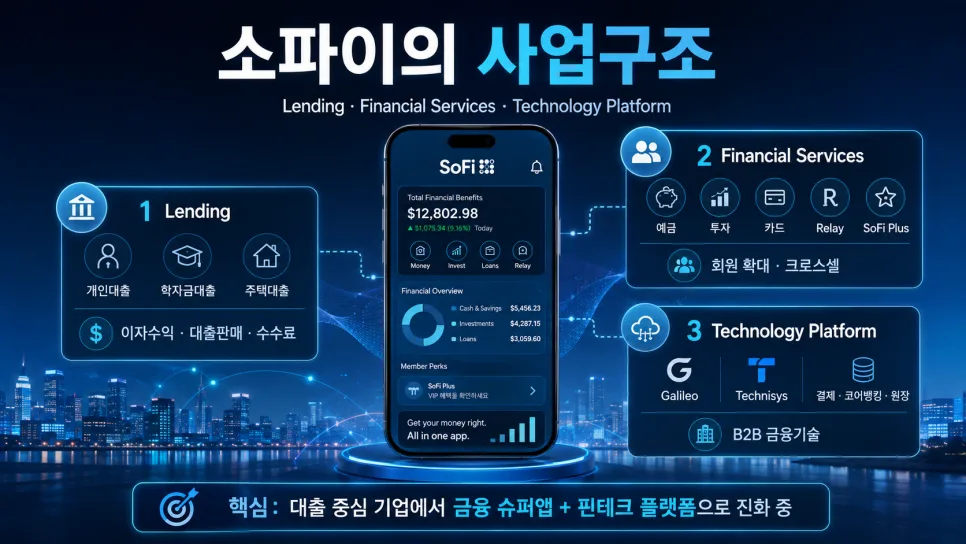
SoFi’s business can be broken into three main segments: Lending, Financial Services, and Technology Platform.
Lending includes personal loans, student loans, and home loans. SoFi earns money both by holding loans and collecting interest, and by originating or selling loans for outside institutions in exchange for fees.
Financial Services includes products like SoFi Money, Invest, credit cards, Relay, Crypto, and SoFi Plus. As members deposit cash, use cards, and invest through the app, SoFi generates a mix of fee income and interest income.
The Technology Platform business is built on Galileo and Technisys, supplying other financial institutions and enterprises with payments, core banking, ledger, and risk management technology.
In the past, SoFi leaned heavily on lending. More recently, though, it has been scaling financial services and fee-based businesses to reduce earnings volatility tied to the economy and interest rates.
Q2 2026 Results Were Clearly Strong
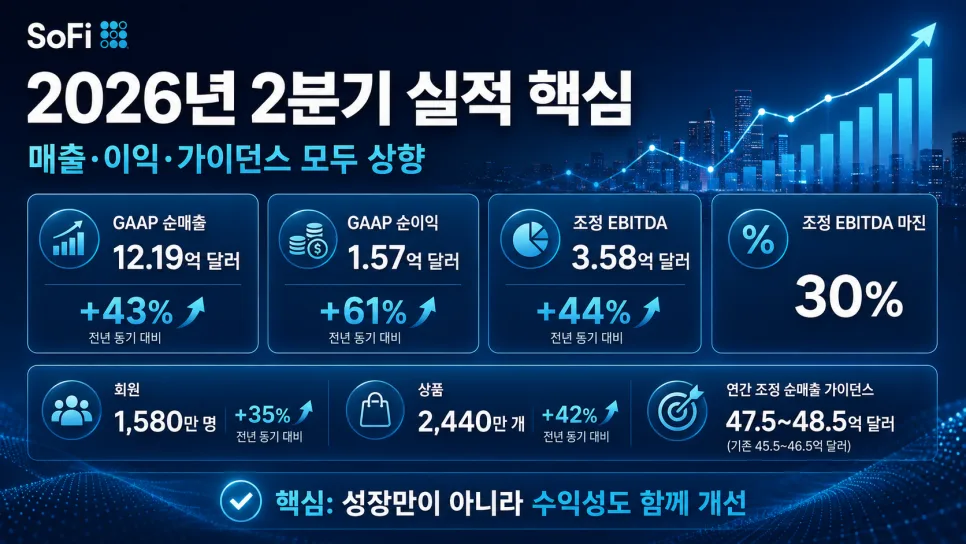
In Q2 2026, GAAP net revenue reached $1.219 billion, up 43% from $855 million in the same quarter last year.
Adjusted net revenue was about $1.206 billion, up 40%. Adjusted EBITDA rose 44% year over year to $358 million, and adjusted EBITDA margin improved to 30%.
GAAP net income came in at $157 million, up 61% from $97 million a year earlier.
Diluted EPS increased to $0.12 from $0.08 last year.
SoFi also said it has now achieved the Rule of 40 for 19 straight quarters, meaning revenue growth and profitability improvement are continuing at the same time.
The company raised its full-year adjusted net revenue outlook to $4.75 billion to $4.85 billion, which implies roughly 32% to 35% growth year over year.
Products Are Growing Faster Than Members
One of the most interesting changes at SoFi isn’t just the rising member count.
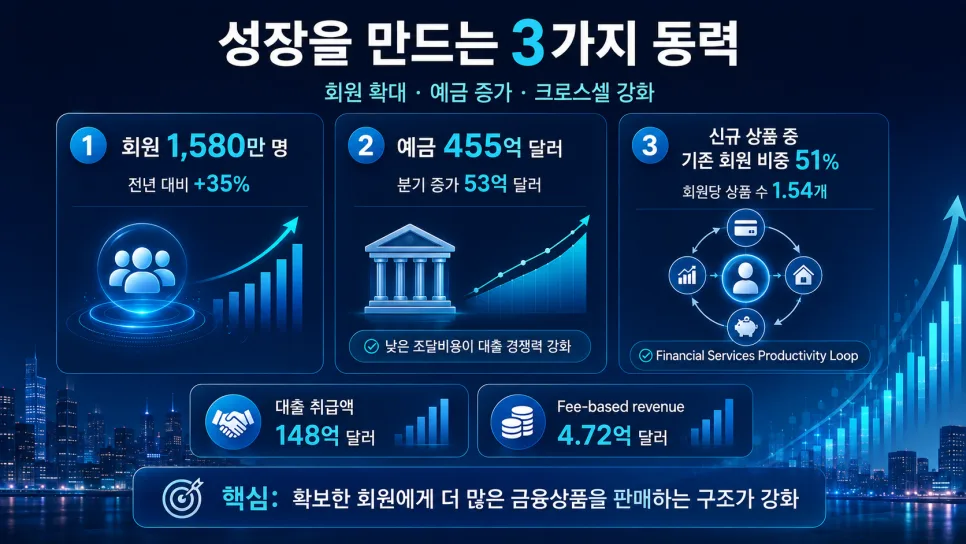
In Q2, total members reached 15.81 million, up 35% year over year. SoFi added about 1.1 million new members in just one quarter.
Total products climbed to 24.38 million, up 42% from a year ago. In Q2 alone, the company added about 2.2 million new products.
For the first time, SoFi added roughly twice as many new products as new members in a single quarter.
Products per member hit a record high of 1.54.
Even more notable, 51% of new products were added by existing SoFi members. That’s up from 43% in the prior quarter and 35% in the same quarter last year.
That suggests SoFi’s Financial Services Productivity Loop is starting to work in real life. Instead of stopping at a checking or savings relationship, SoFi is cross-selling investing, cards, loans, and paid subscriptions to increase customer lifetime value. This is one of the clearest signs in this SoFi stock review that the business model is maturing.
$45.5 Billion in Deposits Is Strengthening Loan Economics
Since securing its bank charter, one of the biggest structural changes at SoFi has been deposits.
At the end of Q2 2026, total deposits stood at about $45.5 billion. That was an increase of $5.3 billion in just one quarter.
Deposits matter because they give SoFi a cheaper source of funding for loans than it had in the past.
In Q2, the average rate SoFi paid on deposits was 1.56 percentage points lower than warehouse financing and other external borrowing sources.
The company said its deposit-heavy funding structure is now saving it about $713 million in annualized interest expense.
Deposits also made up more than 90% of average total liabilities.
In other words, SoFi has moved beyond being a simple loan-referral app. It now looks much more like a bank that gathers customer deposits directly and uses them to fund lending. Lower funding costs can translate into better profitability even on the same loan volume.
In Q2, total net interest income rose 52% year over year to $788 million, while net interest margin, or NIM, came in at 5.98%.
$14.8 Billion in Loan Originations, but the Structure Has Changed
Total loan originations hit a record $14.8 billion in Q2, up 69% from the same period last year.
Personal loan originations were $10.7 billion, student loan originations were about $2.7 billion, and home loan originations were about $1.4 billion.
On the surface, faster loan growth can raise concerns about rising credit risk.
But to understand the full picture, you also have to look at SoFi’s expanding Loan Platform Business.
Instead of holding every loan on its own balance sheet for the long term, SoFi is increasingly originating loans for outside investors and collecting fees.
In Q2, about $3.1 billion in personal loans were originated through the Loan Platform Business. That business contributed about $143 million to adjusted net revenue.
The bigger this model gets, the more SoFi can monetize loan demand without committing huge amounts of its own capital.
I think this is a major shift if SoFi wants to become more of a financial platform than just a lender over the long run.
Fee-Based Revenue Is Becoming a New Growth Engine
In Q2, total fee-based revenue reached $472 million.
That represented about 39% of total revenue.
This includes contributions from the Loan Platform Business, card interchange fees, securities trading fees, and the Technology Platform.
Annualized consumer spend through cards and SoFi Money rose to about $28 billion, and interchange revenue grew 55% year over year.
Securities-related fee revenue also increased by about 2.5 times from a year earlier.
That means SoFi is becoming less dependent on earning money only from interest rates and loan spreads, and more dependent on collecting fees from customers’ broader financial activity.
If fee-based revenue keeps becoming a larger share of the business, it could help reduce earnings volatility even if interest rates fall.
The Technology Platform Is Still a Weak Spot
Not every part of SoFi’s business is firing on all cylinders.
In Q2, revenue from the Technology Platform segment, which includes Galileo and Technisys, was about $84.5 million.
That was up 13% from the prior quarter, but still down 23% compared with the same quarter last year.
Platform accounts also fell 16% year over year to about 135 million.
The impact of one large customer fully leaving the platform is still showing up in the numbers.
SoFi is now combining the legacy Galileo and Technisys brands under SoFi Tech Solutions, bringing Processing, Core Ledger, Payment Hub, and Risk & Fraud together into one platform.
If demand grows in the AI era for financial companies to rebuild their own payments and banking systems, there could be a meaningful long-term opportunity here.
But at this stage, it’s hard to call the Technology Platform a clear growth engine the way consumer financial services are. Whether this segment can return to year-over-year growth is still one of the biggest things to watch in any SoFi stock review.
Can SoFi Plus and AI Increase Value Per Customer?
Lately, SoFi has been expanding beyond the idea of a simple free finance app into subscriptions and AI.
SoFi Plus was upgraded and converted into a paid subscription model, and by the end of Q2 it had about 206,000 paying subscribers.
Among existing members who signed up for SoFi Plus, 25% later added at least one more product.
That means the subscription fee itself may matter less than SoFi Plus’s ability to get customers to use more services inside the SoFi ecosystem.
The company is also expanding its AI financial guide, SoFi Coach. Since launch, it has generated about 500,000 conversations, and management said more than 90% of user feedback has been positive.
On the investing side, SoFi also launched Composer by SoFi, an AI-powered investment platform.
If these AI features do more than just add novelty—and actually improve conversion and cross-sell—SoFi could increase revenue per customer even further.
Current Stock Price and Valuation
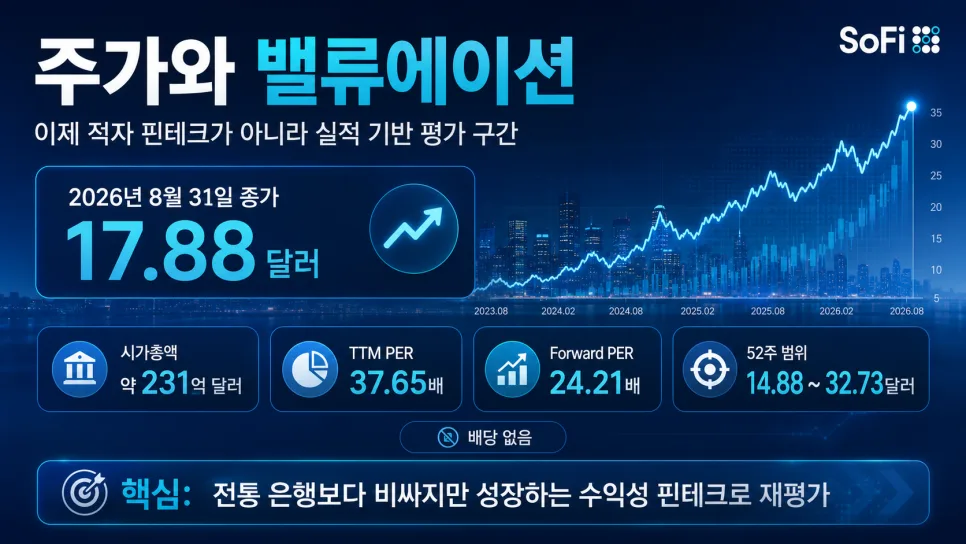
As of August 31, 2026, SOFI closed at $17.88.
Its 52-week range is $14.88 to $32.73. Compared with last year’s high, the stock has pulled back significantly.
SoFi’s current market cap is about $23.1 billion.
Over the last 12 months, revenue was about $4.27 billion and net income was about $636 million.
TTM P/E is about 37.7x, and forward P/E is about 24.2x.
That’s a rich valuation compared with traditional bank stocks. The market is still valuing SoFi as a faster-growing fintech company rather than a plain-vanilla bank.
On the other hand, for a fintech growing members and revenue by more than 30% while also posting real GAAP net income, valuation is easier to assess now than it was during the loss-making years.
SoFi does not pay a dividend. Right now, the company is still in the stage of using capital to expand membership, launch new financial products, and invest in its technology platform.
Pros and Cons
Pros
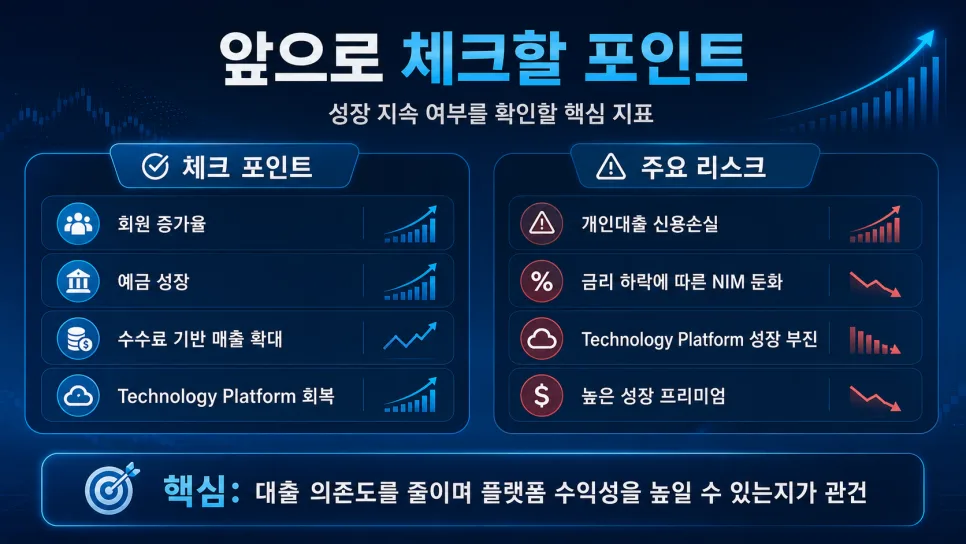
• Q2 GAAP net revenue rose 43% and net income increased 61%, showing both growth and profitability at the same time.
• With 15.8 million members and 24.4 million products, SoFi is rapidly expanding both its customer base and cross-sell depth.
• Existing members accounted for 51% of new products, showing a model that is increasing customer lifetime value.
• With $45.5 billion in deposits, SoFi is materially lowering its loan funding costs.
• Through the Loan Platform Business and rising fee revenue, SoFi is reducing its dependence on capital-intensive lending.
• Management raised full-year 2026 adjusted net revenue guidance to $4.75 billion to $4.85 billion.
Cons
• Loan originations, especially personal loans, are growing quickly, which could increase credit-loss risk in a recession.
• Technology Platform revenue fell 23% year over year and still has not shown a full recovery.
• A forward P/E in the mid-20s gives the stock a higher growth premium than traditional financial companies.
• If interest rates fall quickly, growth in net interest margin and net interest income could slow.
• SoFi has to compete with large players across banking, fintech, brokerage, and crypto at the same time.
• Rapid product expansion could also lead to higher marketing and operating costs.
Final Take
Looking at SoFi again today, it’s clearly a very different company from the one investors knew a few years ago.
Back then, it looked like a fast-growing fintech with unclear profitability. Now it looks much more like a scaled financial company generating more than $1.2 billion in quarterly net revenue and over $150 million in quarterly net income.
Member growth is still strong. In just one year, members increased 35% and total products rose 42%.
Personally, the most important shift is that products are now growing faster than members.
When more than half of new products are being adopted by existing members, SoFi can generate more revenue from each customer without having to spend heavily on fresh marketing every single time.
The deposit base also looks strong. With $45.5 billion in deposits, SoFi can fund loans with much cheaper capital than before.
I also like the growth of the Loan Platform Business and fee revenue. If SoFi can keep using outside capital instead of holding every loan on its own books, capital efficiency should improve.
On the flip side, the Technology Platform is still an obvious weakness. If Galileo and Technisys fail to return to growth, it may make more sense to value SoFi as a fast-growing digital bank rather than a broader financial platform.
At $17.88, a forward P/E of about 24x is not cheap by bank-stock standards.
So in the next earnings report, I’ll be watching member growth, cross-sell from existing members, fee-based revenue, deposit growth, credit losses, and Technology Platform growth before I focus on the stock price itself.
In particular, if the company delivers its 2026 full-year targets of $4.75 billion to $4.85 billion in adjusted net revenue and about $1.6 billion in adjusted EBITDA, the case that SoFi is moving from a growth stock into a profitable financial platform will look even stronger.
Sources
• SoFi Technologies Q2 2026 Earnings Release
• SoFi Technologies Q2 2026 Earnings Presentation
• SoFi Technologies Q2 2026 Form 10-Q
• SoFi Technologies Investor Relations
• StockAnalysis market data, as of August 31, 2026
#sofi #SoFi #SOFI #sofi stock #SOFI stock #us stocks #us stock analysis #fintech stocks #digital bank #us financial stocks #SoFi Bank #SoFi Plus #SoFi Coach #Galileo #Technisys #financial platform #growth stocks #Nasdaq #international stocks #stock research #us stock investing