Companies like NVIDIA and AMD get most of the spotlight because they design AI chips directly, but actually making those chips takes hundreds of semiconductor process steps. And the more complex chip architectures become, the more important manufacturing equipment gets.
Lam Research is a U.S. semiconductor equipment company with particular strength in etch, deposition, and cleaning tools. As areas like 3D NAND, HBM, advanced logic, and advanced packaging continue to grow—basically, any segment where chip structures need to get deeper and more complex—the number of process steps that require Lam Research equipment also increases.
In fiscal 2026, Lam Research posted $23.233 billion in revenue, up 26% year over year, while net income rose to $7.265 billion. In the June 2026 quarter, revenue reached $6.722 billion, up 15.1% from the prior quarter, and the company guided next-quarter revenue to $8.1 billion.
That said, the stock price already reflects a lot of that growth optimism. As of August 28, 2026, LRCX closed at $301.90. It has pulled back from its highs, but it still trades at a richer valuation than many traditional semiconductor equipment stocks.
How Lam Research Makes Money
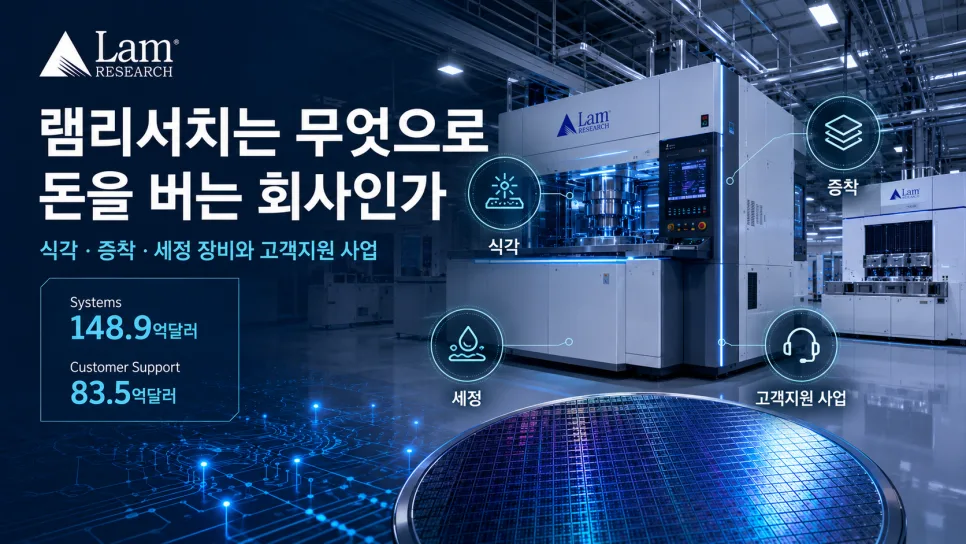
Lam Research sells deposition tools that build ultra-thin films on wafers, etch tools that precisely carve out the needed areas, and cleaning equipment that removes contaminants created during manufacturing. As chip circuits shrink and structures become more vertical and three-dimensional, the precision required in each of these steps becomes dramatically more important.
Its revenue model breaks down into two major businesses: Systems, which sells new semiconductor equipment, and Customer Support, which maintains installed tools and provides parts and upgrades.
In fiscal 2026, Systems revenue came in at about $14.885 billion, while Customer Support-related revenue was about $8.347 billion. So this is not just a story of selling new tools—Lam also generates recurring revenue from equipment already installed in semiconductor fabs around the world.
That matters a lot when the semiconductor equipment cycle gets shaky. Even if new fab investment slows, existing production lines still have to keep running, so demand for consumables, maintenance, and performance upgrades does not disappear overnight.
The June 2026 Quarter Was Very Strong
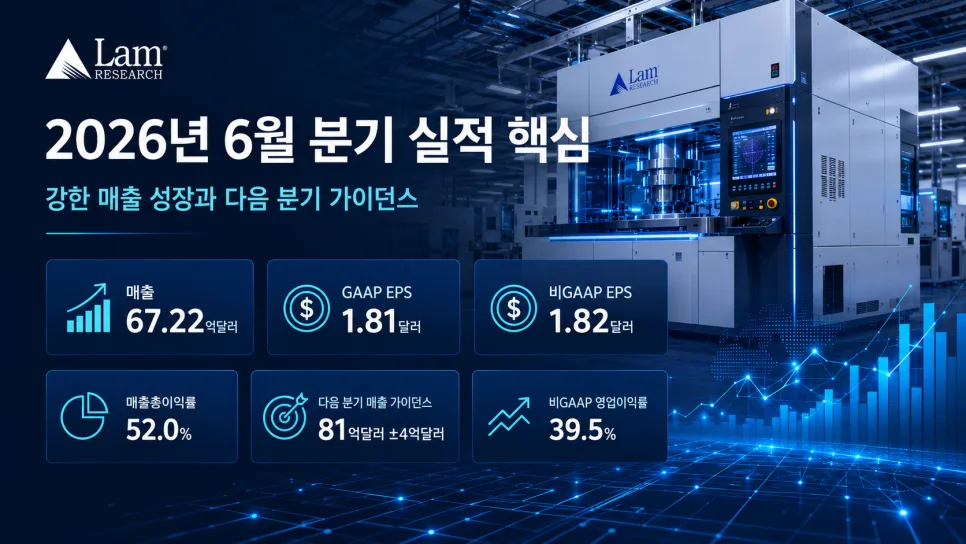
Revenue for the June 2026 quarter was $6.722 billion, up 15.1% from $5.841 billion in the March quarter. On a GAAP basis, gross margin was 51.7%, operating margin was 37.4%, and diluted EPS came in at $1.81.
On a non-GAAP basis, gross margin was 52.0%, operating margin was 38.4%, and diluted EPS was $1.82. Compared with non-GAAP EPS of $1.47 in the prior quarter, that is roughly 24% growth in just one quarter.
What stands out even more is the next-quarter guidance. Lam Research projected September 2026 quarter revenue of $8.1 billion, plus or minus $400 million. Non-GAAP operating margin guidance was 39.5%, and EPS guidance was $2.15, plus or minus $0.15.
That tells you the demand environment the company is seeing right now is still very strong. The key point from management is that expanding AI investment is lifting semiconductor capital spending across both memory and non-memory markets.
Why Lam Research Stock Benefits as AI Chips Get More Complex
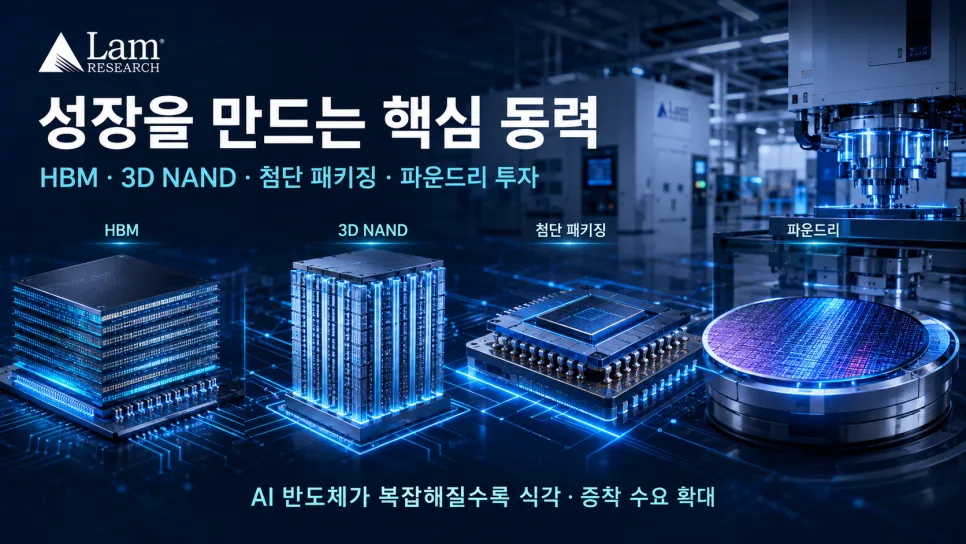
The semiconductor industry can no longer keep boosting performance simply by shrinking circuit widths the way it used to. NAND is already stacking cells vertically, DRAM structures are getting more complicated, and logic chips are moving toward new transistor architectures and technologies like backside power delivery.
To stack more layers, manufacturers need to etch deep, narrow holes with uniformity and then coat those interiors with atomically thin films. That is exactly where Lam Research’s etch and deposition technologies become essential.
In its fiscal 2026 annual report, the company also pointed to 3D structures, multi-patterning, new materials, and advanced packaging as long-term drivers of equipment market expansion. What matters here is that as AI chip performance rises, it is not just wafer volume that increases—the difficulty of making each wafer goes up too.
In other words, Lam Research stock can benefit not only from higher AI chip unit demand, but also from the growing number of equipment-intensive process steps required to make each chip.
HBM and 3D Memory Are Major Growth Drivers
One of the most important components in today’s AI servers is HBM, or High Bandwidth Memory. Because HBM boosts bandwidth by stacking multiple DRAM dies vertically, it requires much more complex manufacturing and packaging processes than conventional memory.
Lam Research supplies the etch, deposition, copper plating, and through-silicon via-related equipment needed in HBM production. Product families like SABRE, Syndion, and Striker are used in HBM and advanced packaging applications.
3D NAND is also a major long-term opportunity. As layer counts rise, NAND requires increasingly deep and precise etching, and that has been one of Lam Research’s core strengths for years.
Looking at fiscal 2026 equipment revenue by end market, foundry accounted for 54%, memory for 39%, and logic/IDM for 7%. That mix is worth watching because Lam Research used to be seen as more memory-dependent, but it is now also benefiting meaningfully from rising foundry investment.
Expanding Into Advanced Packaging
In AI semiconductors, it is no longer just the chip itself that matters. The technology used to connect multiple chips into a single package has become just as important. To place GPUs and HBM close together and make more chips function like one system, packaging complexity rises sharply.
In 2026, Lam Research established a panel-level packaging research hub in Salzburg, Austria, and it is also expanding advanced packaging tools like SABRE 3D. If package production moves from wafer-level to larger panel-level formats, that could open up a new market in both productivity and cost efficiency.
The company is also investing aggressively in R&D. Lam Research plans to invest more than $3 billion over the next five years to expand its global lab network, and in August 2026 it began expansion work at its Oregon research center.
Once the new facility is completed, cleanroom space at that R&D center is expected to increase by more than 50%. As process changes accelerate in the AI era, the ability to test new manufacturing steps quickly and close to customers is becoming a competitive advantage in itself.
Customer Support and Cash Flow Are Also Strengths
Lam Research is not just a company that sells new tools. In fiscal 2026, Customer Support-related revenue totaled about $8.347 billion, accounting for more than 35% of total revenue.
Semiconductor equipment is typically used for years after installation, and along the way it needs replacement parts, scheduled maintenance, and ongoing software and hardware upgrades. The larger the installed base becomes, the bigger the foundation for recurring future revenue.
Operating cash flow in fiscal 2026 was about $5.86 billion. At the end of June, cash and cash equivalents stood at about $5.58 billion, while total debt was around $3.72 billion, which makes the balance sheet look relatively solid.
That combination—a growing installed base from equipment sales followed by rising Customer Support revenue—looks like a pretty attractive long-term business model to me.
Stock Price, Valuation, and Shareholder Returns
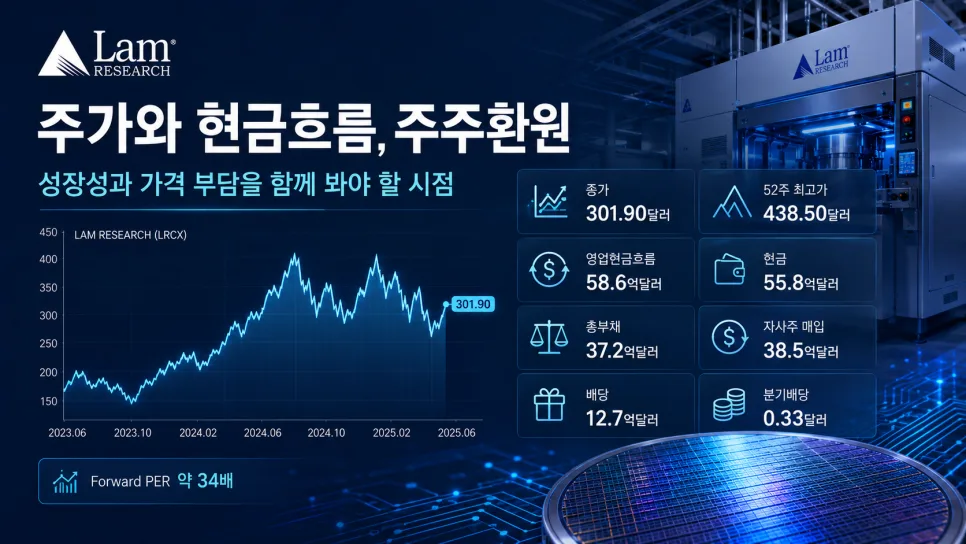
As of August 28, 2026, LRCX closed at $301.90. Its 52-week high was $438.50, so the stock was down about 31% from its recent peak.
But a big pullback from the highs does not automatically make it cheap. Based on recent market data, the trailing twelve-month P/E was about 55x, while forward P/E was around 34x. In other words, the stock already prices in the expectation that AI semiconductor equipment demand will stay strong for quite a while.
Shareholder returns have been fairly aggressive. In fiscal 2026, the company spent about $3.85 billion on share repurchases and related buyback activity, and paid about $1.27 billion in cash dividends.
On top of that, on August 27, 2026, Lam Research raised its quarterly dividend by 27%, from $0.26 per share to $0.33. The dividend yield itself is still low at roughly 0.4% at the current stock price, but it is meaningful that the company is growing the dividend while also buying back stock.
Pros and Cons
Pros
• Rising AI investment is driving both memory and foundry capital spending higher.
• Etch and deposition become more important as processes grow more complex in 3D NAND, HBM, and advanced logic.
• Fiscal 2026 results backed up the growth story, with revenue up 26% and net income up 35.6%.
• The Customer Support business generates more than $8.3 billion annually, helping cushion some of the volatility in the equipment cycle.
• Cash generation is strong, and the company is executing both share repurchases and dividend increases.
Cons
• With forward P/E well above 30x, valuation remains demanding even within the semiconductor equipment sector.
• The semiconductor equipment industry can see large earnings swings depending on customers’ capital spending cycles.
• In fiscal 2026, 34% of total revenue came from China, making the company sensitive to China-related export controls and U.S.-China tensions.
• Customer concentration is high: in fiscal 2026, four large customers accounted for 16%, 15%, 12%, and 12% of total revenue, respectively.
• If AI investment enthusiasm cools or memory and foundry expansion plans get delayed, the stock’s premium valuation could compress quickly.
What to Watch in the Next Earnings Report
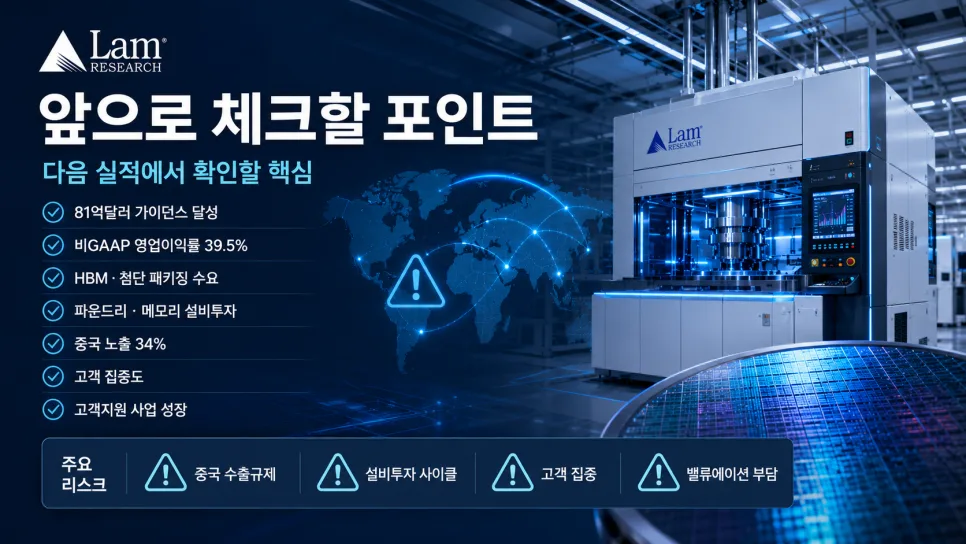
The first number I will be watching next quarter is whether the company actually hits its $8.1 billion revenue guidance. Considering June quarter revenue was $6.722 billion, management is clearly expecting another major step up based on the midpoint of guidance.
-
Whether revenue guidance of $8.1 billion ± $400 million is achieved
-
Whether non-GAAP gross margin holds around 52%
-
Whether non-GAAP operating margin reaches 39.5%
-
Whether demand growth for HBM and advanced packaging equipment continues
-
The strength of foundry and memory customer capex
-
The impact of China export controls on revenue
-
Whether Customer Support growth and installed base expansion continue
Personally, I plan to watch margins just as closely as revenue growth. Even if the AI investment cycle stays strong, it will be hard to justify today’s premium valuation if tariffs, supply chain costs, or product mix changes start dragging margins lower.
Final Take
Lam Research is in a genuinely interesting position in the AI semiconductor era. You do not have to correctly predict which company’s GPU will win the market to invest in the industry structure itself—because making more complex chips still requires etch and deposition equipment.
With fiscal 2026 revenue of $23.2 billion, net income of $7.2 billion, and next-quarter revenue guidance raised to $8.1 billion, the current business environment looks very strong. On top of that, the company has multiple growth drivers at once: HBM, 3D NAND, advanced packaging, and next-generation logic.
What I like most is not just that new equipment sales are rising. As more tools get installed, maintenance and upgrade revenue builds on top of that base, which means the value of the Customer Support business could keep growing over time.
On the flip side, the biggest concern is price. Even after falling to $301.90 as of August 28, 2026, the stock still trades at roughly 34x forward earnings, which means the market is already demanding sustained high growth. A great company and a cheap stock are not the same thing.
That is why I would not look at Lam Research stock simply as an AI beneficiary. I think it makes more sense to watch the next two to three quarters and see whether revenue in the $8 billion range is actually sustained, whether HBM and advanced packaging demand turns into real equipment orders, and whether gross margins in the 50% range hold up.
The business is clearly strong right now, but the stock price is carrying equally high expectations. In the end, the most important question for Lam Research stock is not just whether AI semiconductors keep growing, but how long that growth translates into real wafer manufacturing equipment investment.
Sources
• Lam Research fiscal 2026 Form 10-K
• Lam Research June 2026 quarterly earnings release
• Lam Research June 2026 Earnings Presentation
• Lam Research official product materials and Advanced Packaging materials
• Lam Research global R&D investment announcement
• Lam Research dividend increase announcement, August 27, 2026
• Schwab and Yahoo Finance market data, as of August 28, 2026
#lamresearch #lrcx #lamresearchstock #usstocks #stockanalysis #semiconductorstocks #semiconductorequipment #aichips #hbm #3dnand #advancedpackaging #etchtools #depositiontools #nasdaq #growthstocks