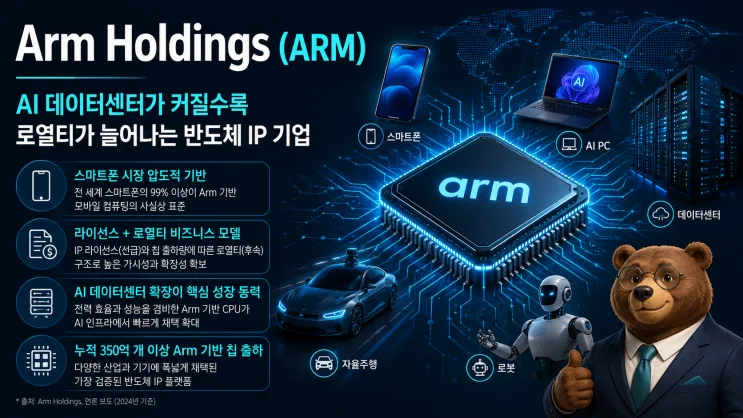
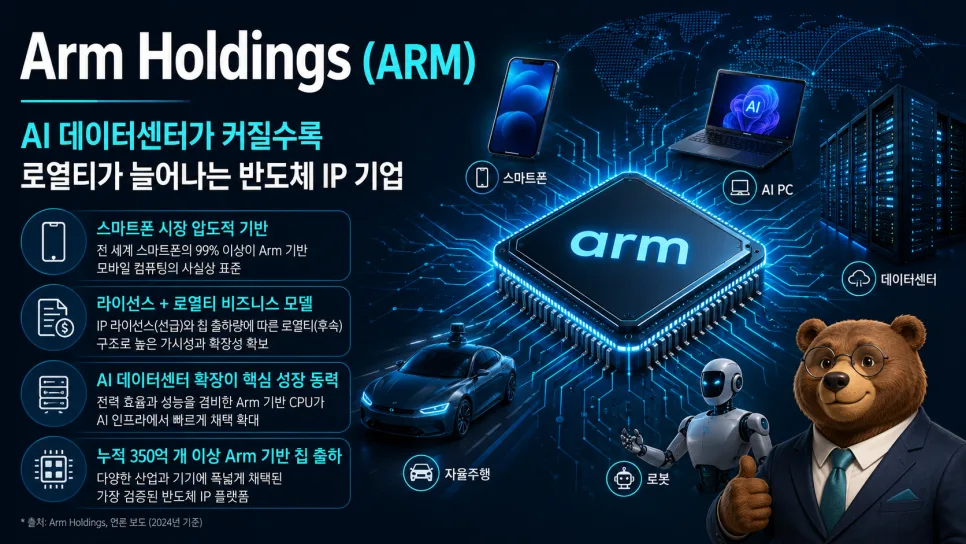
When people think about AI semiconductors, they usually jump straight to NVIDIA GPUs or TSMC’s cutting-edge manufacturing. But from smartphones and servers to cars and AI PCs, there’s another common layer inside an enormous number of chips: Arm’s CPU architecture and design technology.
Arm doesn’t operate like a traditional chip company that manufactures semiconductors at scale and sells finished products. Its core business is licensing CPU and system design technology to semiconductor companies, then collecting royalties every time chips using that technology are actually shipped.
In fiscal 2027 Q1, revenue came in at $1.289 billion, up 22% year over year. Royalty revenue reached $715 million, while license and other revenue totaled $574 million, with both segments growing 22% and 23%, respectively.
What really stands out is how quickly Arm-based CPU adoption is rising in AI data centers. As that trend accelerated, data center royalties more than doubled from a year earlier. The challenge, of course, is the stock price. As of the most recently completed trading day, August 28, 2026, ARM closed at $239.05, with a forward P/E of roughly 100.
The business has strong growth potential, but it’s also a stock carrying very high market expectations.
What Arm makes money from
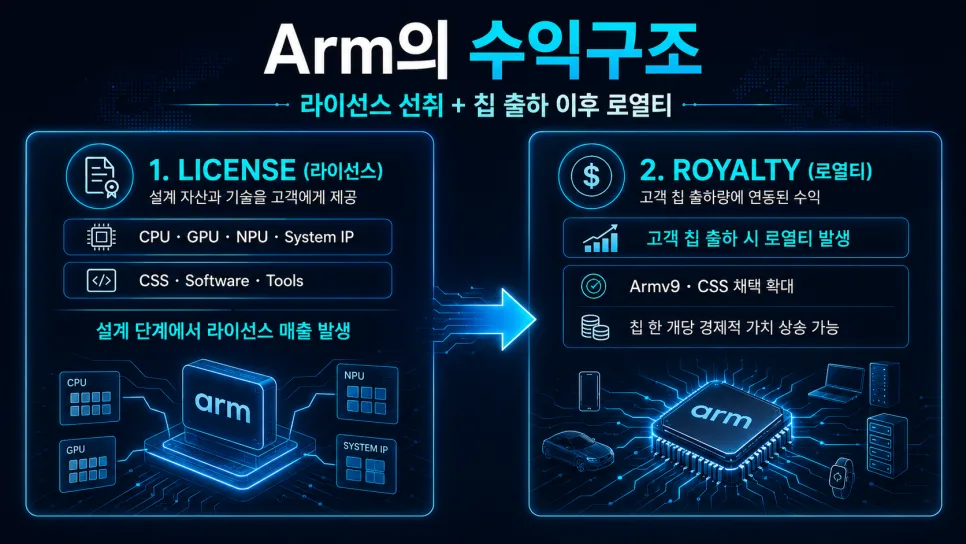
Arm is not a company that owns fabs and stamps out chips. It sells the core intellectual property needed to design semiconductors.
Its main offerings include CPU IP, accelerator IP such as GPUs and NPUs, system IP like interconnects, pre-integrated Compute Subsystems, and development software and tools.
When a customer wants to design a new chip using Arm technology, the first step is signing a license agreement. That is where License and Other Revenue comes from.
After that, once the customer actually manufactures and sells chips built on that technology, Arm collects royalties based on shipment volume.
For full-year fiscal 2026, Arm generated $4.92 billion in revenue. Of that, $2.613 billion came from royalties and $2.307 billion came from license and other revenue.
Because Arm sells design technology first and then earns long-tail royalties if the customer’s chip succeeds, its biggest asset isn’t a factory. It’s the design ecosystem.
To date, more than 350 billion Arm-based chips have shipped cumulatively, and over 99% of smartphones use Arm-based processors. Its software developer ecosystem now exceeds 22 million people.
How fiscal 2027 Q1 looked
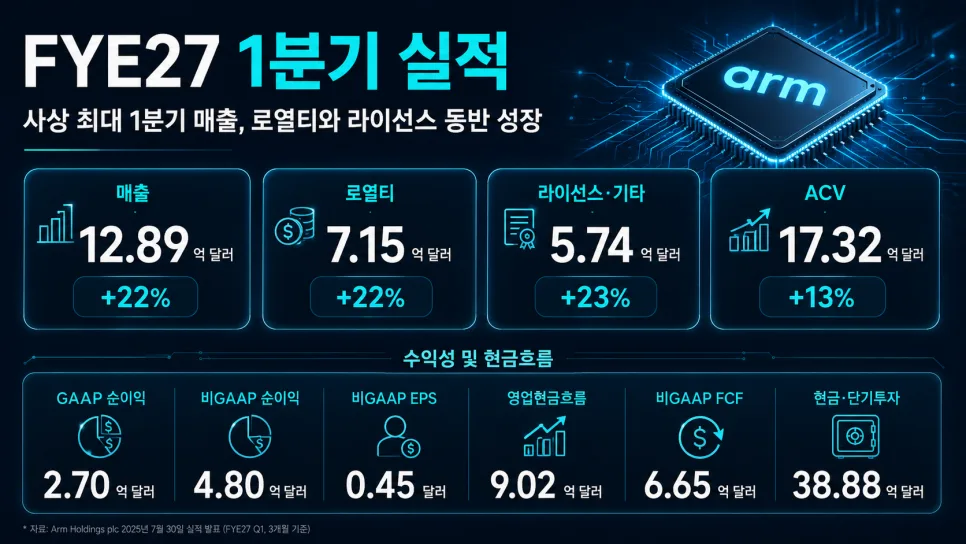
For the quarter ended in late June 2026, Arm posted fiscal 2027 Q1 revenue of $1.289 billion. That was up 22% from $1.053 billion in the same period last year, marking the highest first-quarter revenue in the company’s history.
Royalty revenue rose 22% to $715 million. License and other revenue also increased 23% to $574 million.
Annualized contract value, or ACV, reached $1.732 billion, up 13% year over year. That suggests the base of new license agreements is still expanding.
GAAP net income was $270 million, up 108% from a year earlier, and diluted EPS came in at $0.25.
Non-GAAP net income was $480 million, with diluted EPS of $0.45. Non-GAAP operating margin improved to 41.2%, up from 39.1% a year ago.
Cash flow from operations was $902 million, and non-GAAP free cash flow was $665 million.
At quarter-end, cash, cash equivalents, and short-term investments totaled about $3.888 billion.
Why royalties matter so much over the long run
In Arm’s business model, I think royalty revenue matters even more than license revenue.
License revenue can swing sharply from quarter to quarter depending on when large contracts get signed, but royalties are tied to the shipment volume of Arm-based chips already embedded across the market.
And lately, it’s not just the number of chips shipping that’s increasing. The economic value Arm captures per chip is also rising.
Chips built on newer architectures like Armv9 can command higher royalty rates than older generations, and as adoption of integrated platforms like Arm CSS grows, the value Arm can capture from each customer can increase as well.
In fact, key drivers behind Q1 royalty growth included broader Armv9 adoption, rising use of Arm CSS, and expanding deployment of Arm-based chips for data centers.
In other words, the best-case scenario for Arm isn’t just higher global semiconductor unit volume. It’s a larger mix of high-value chips built on premium Arm technology.
AI data center growth is the new core market
Historically, Arm’s biggest strength was smartphones. In the mobile market, where power-efficient design matters most, Arm architecture became the closest thing to an industry standard.
The most important shift now is that this advantage is moving into the data center.
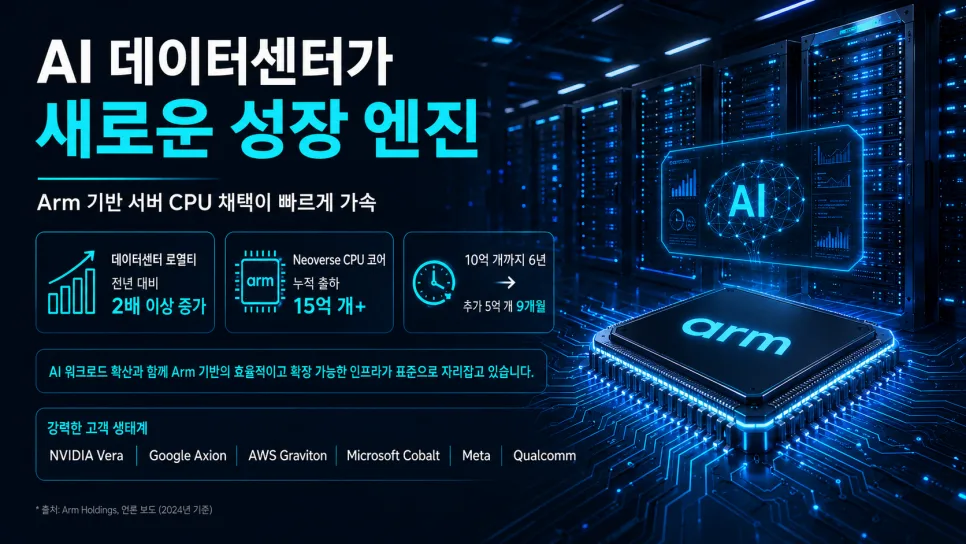
In fiscal 2027 Q1, data center royalties more than doubled year over year. Cumulative shipments of Arm Neoverse-based CPU cores have now surpassed 1.5 billion.
The speed is especially interesting. It took about six years to ship the first 1 billion Neoverse cores, but only nine months to add the next 500 million.
NVIDIA’s next-generation AI infrastructure CPU, Vera, is also Arm-based, and Google is using its Axion CPU in AI infrastructure.
AWS continues expanding its Graviton family and announced a multiyear agreement with Meta to deploy tens of millions of Graviton5 cores.
Microsoft is also scaling Azure Cobalt 200, which is based on Arm Neoverse CSS, and Qualcomm is pushing into the Arm-based AI data center CPU market as well.
AI data center growth matters because these systems don’t just need GPUs. They also need CPUs to orchestrate the GPUs and handle a wide range of system tasks, which expands Arm’s addressable market.
In power-sensitive data center environments, Arm’s traditional advantage in performance per watt could become even more valuable than it was in the past.
Arm AGI CPU is both an opportunity and a business-model shift
In March 2026, Arm introduced the Arm AGI CPU, moving into territory that looks meaningfully different from its historical business.
Traditionally, Arm was closer to a company that supplied IP so customers could design their own chips. With the AGI CPU, it is extending further into the world of finished production silicon.
Initially, the company outlined an opportunity of about $1 billion for the AGI CPU across fiscal 2027 and fiscal 2028.
But in the fiscal 2027 Q1 release, management said customer demand was ramping faster than expected, with the related demand pipeline for that same period now exceeding $2 billion.
The company also said it has already secured the manufacturing capacity needed to support the original $1 billion demand target.
If this works, Arm could capture more value directly than it does through IP licensing and royalties alone.
On the flip side, the risks rise too. Once a company starts supplying silicon directly, it has to shoulder risks that were previously much smaller for Arm, including foundry capacity, yield, packaging, inventory, and supply chain execution.
It could also create competitive tension with existing Arm customers that design or sell server CPUs themselves.
That’s why I see the AGI CPU as more than just a new product. It’s a major experiment that could reshape Arm’s business model.
AI PCs, edge computing, and robotics are growing too
Arm’s AI growth story doesn’t end with the data center.
AI models are no longer running only in the cloud. On-device AI is expanding across PCs, smartphones, cars, and robots, where models run directly on the device itself.
That plays directly into one of Arm’s longest-standing strengths: power efficiency and battery life.
NVIDIA announced RTX Spark based on Arm Compute Subsystems, and major PC makers including Acer, ASUS, Dell, HP, and Lenovo are preparing related systems.
Windows on Arm PCs powered by Qualcomm Snapdragon are also continuing to expand across the market.
In cars and robotics, systems need to sense their surroundings and make decisions in real time while keeping power consumption under control, which broadens the range of use cases for Arm-based CPUs.
Platforms like NVIDIA Jetson Thor already show how Arm CPUs and GPUs are being combined in robotics and Physical AI systems.
Ultimately, the long-term investment case for Arm depends on whether it can expand from being known as a smartphone chip architecture company into a shared computing platform for the AI era.
High R&D spending needs to be watched closely
If you only look at gross margin, Arm looks incredibly strong.
In fiscal 2027 Q1, GAAP gross margin was 97.2%, and non-GAAP gross margin was 98.1%.
But GAAP operating margin was only 7.1%. That was actually down from 10.8% a year earlier.
The reason is R&D investment.
In Q1, GAAP R&D expense rose 29% year over year to $838 million. Total GAAP operating expenses increased 28% to $1.162 billion.
Arm is investing simultaneously in CPU architecture, CSS, AI development tools, the AGI CPU, and future silicon products.
If today’s elevated R&D spending turns into future royalties and silicon revenue, that will look like smart investment.
But if commercialization of new products takes longer than expected, revenue may keep growing while GAAP operating margin stays depressed for a long time.
That’s why it’s important to look beyond the non-GAAP numbers and track real R&D costs alongside GAAP margins.
Valuation is the biggest overhang
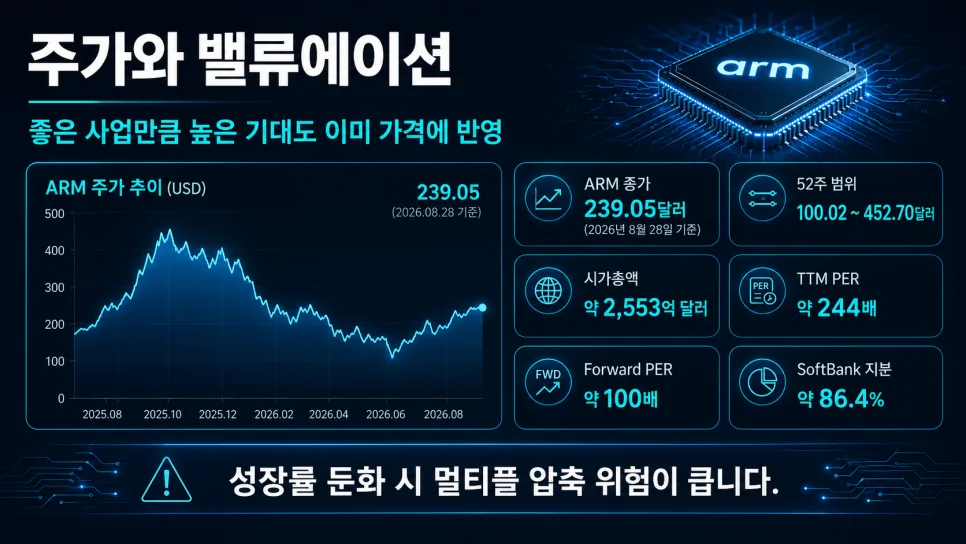
As of the most recently completed trading day, August 28, 2026, ARM closed at $239.05.
Its 52-week range is $100.02 to $452.70, which shows just how volatile the stock has been. It’s well off the highs, but still more than double its 52-week low.
Market capitalization stands at about $255.3 billion.
Over the last 12 months, Arm generated about $5.16 billion in revenue, yet its market cap is above $250 billion. That tells you the market is pricing in much more than current results, especially around AI data center growth and the AGI CPU opportunity.
TTM P/E is about 244, and forward P/E is roughly 100.
By the standards used for most semiconductor companies, that is an extremely rich valuation.
The stock’s beta is also around 3.9, making it highly sensitive to market swings.
In the end, good results alone may not be enough for ARM. To justify today’s premium, the company likely has to keep proving faster-than-expected AI data center growth, higher royalty rates, and successful execution on the AGI CPU.
Another point worth checking is governance. As of May 2026, SoftBank Group owned about 86.4% of Arm’s outstanding shares.
Arm qualifies as a Controlled Company under Nasdaq rules, which means ordinary shareholders have relatively limited influence over company decision-making.
Pros and cons
Pros
• Arm has a powerful global ecosystem, with Arm-based processors used in more than 99% of smartphones.
• In fiscal 2027 Q1, both revenue and royalties grew 22%, showing that even a large platform company can still deliver strong growth.
• AI data center royalties more than doubled year over year, opening up a major new market beyond smartphones.
• As Armv9 and Arm CSS adoption expands, royalty value per chip could rise, not just total chip shipments.
• Customer demand for the AGI CPU is scaling faster than the company originally expected.
• More than 350 billion cumulative chip shipments and a developer ecosystem of over 22 million are assets competitors cannot easily replicate in the short term.
Cons
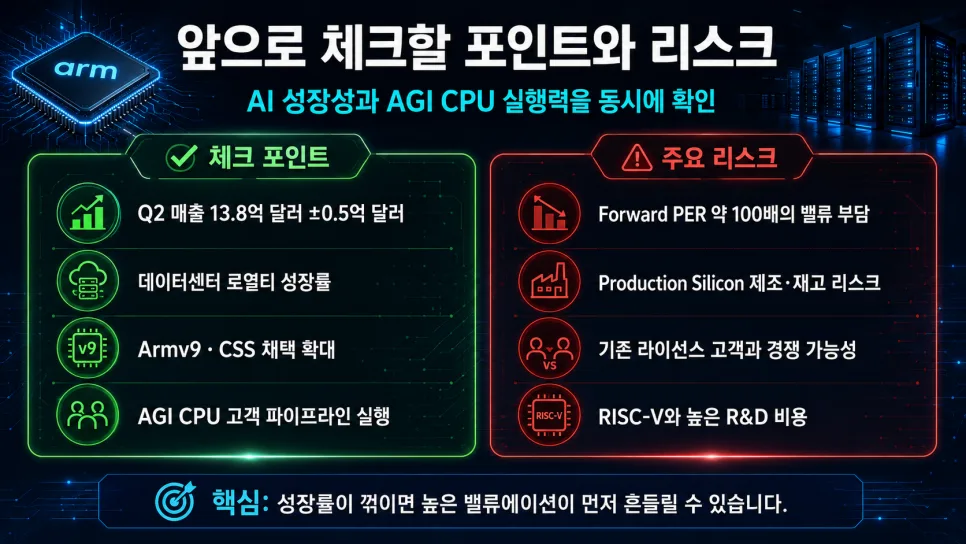
• With a forward P/E of around 100, the current valuation is very demanding.
• Arm’s move into direct silicon, including the AGI CPU, introduces new manufacturing, supply chain, and inventory risks.
• A production silicon business could create actual or potential competition with existing license customers.
• Open architectures like RISC-V could become a long-term competitive threat to Arm’s licensing model.
• As GAAP R&D spending rises quickly, GAAP operating margin remains stuck at 7.1%.
• Because SoftBank controls about 86.4% of the shares, ordinary shareholders have limited voting influence.
Final thoughts
Looking at Arm, one thing becomes very clear: in the AI era, you don’t have to manufacture GPUs yourself to hold a powerful position in the semiconductor stack.
AI data center growth, AI PCs, smartphones, cars, and robots may look like completely different end markets, but there’s a growing chance they all rely on the same CPU foundation inside: Arm.
The fact that data center royalties more than doubled in Q1 and Neoverse shipment momentum is accelerating is one of the most encouraging signals here.
It also matters that Armv9 and Arm CSS could lift the royalty value earned from each chip. That’s a better setup than a business that only makes more money if the entire semiconductor market grows.
The AGI CPU could become an even bigger opportunity. The fact that the customer demand pipeline is already growing faster than the company’s original $1 billion target is clearly a positive sign.
That said, this is also where the biggest risk sits. Once an IP licensing company moves directly into silicon, part of the business shifts from a high-margin model into one that also has to manage manufacturing and supply chain risk.
And above all, the stock is expensive. Even at $239.05, the forward P/E is still around 100.
Deciding whether Arm is a great company and deciding whether it is a great investment at today’s price are two very different questions.
In the next earnings report, I’ll be watching first for whether the company hits its Q2 revenue guidance of $1.38 billion plus or minus $50 million, along with non-GAAP EPS of $0.47 plus or minus $0.04.
I’ll also be paying close attention to data center royalty growth, Armv9 and CSS adoption, the AGI CPU customer pipeline, and the pace of R&D spending.
If those numbers stay strong, the case for valuing Arm not just as a smartphone IP company but as a general-purpose computing platform for the AI era gets much stronger.
If growth drops quickly below 20%, or if AGI CPU execution falls short of expectations, the current valuation leaves plenty of room for a sharp stock correction.
Sources
Arm Holdings Fiscal 2027 Q1 Shareholder Letter
Arm Holdings Q1 FYE27 Investor Presentation
Arm Holdings 2026 Form 20-F
Arm Holdings Investor Relations
StockAnalysis market data, as of August 28, 2026
#armholdings #arm stock #arm review #us stocks #stock analysis #ai semiconductors #semiconductor stocks #semiconductor ip #armv9 #neoverse #ai data center #ai server #agi cpu #ai computing #nasdaq #global stocks #investing #stock research #growth stocks