

To use AI well, a company first needs to be able to find and connect its data in one place. Even the best AI model is hard to apply in the real world if customer information, sales data, product records, and internal documents are scattered across different systems.
Snowflake is one of the leading cloud data platforms built to solve exactly that problem. It used to be known mainly as a cloud data warehouse company, but now it is pushing its AI Data Cloud as the core business, combining analytics, data sharing, application development, and AI in one platform.
Recent results show growth is picking up again. In fiscal 2027 first quarter, product revenue came in at $1.33 billion, up 34% year over year, while total revenue reached $1.391 billion, up 33%.
That said, the stock has already run up a lot. As of August 28, 2026, SNOW closed at $328.00, not far from its 52-week high of $341.95. Strong business momentum and an attractive stock price are two very different questions.
How Snowflake makes money

At its core, Snowflake is a cloud platform where companies can store data, analyze it, and securely share it across teams and even with outside partners.
It runs on public cloud infrastructure like AWS, Microsoft Azure, and Google Cloud, but one of its biggest strengths is that it is not locked into a single cloud. Customers can connect and use data across multiple clouds.
More specifically, Snowflake offers data warehousing, data lakes, data engineering, data analytics, application development, data sharing, cybersecurity analytics, and AI services inside one platform.
Snowflake also works differently from a traditional SaaS company. Instead of charging a flat subscription fee per user, it mainly uses a consumption-based model, where revenue depends on how much computing power, storage, and other resources customers actually use.
That means revenue can grow naturally as customers move more data and more workloads onto Snowflake and increase usage over time.
Growth accelerated again in the latest results
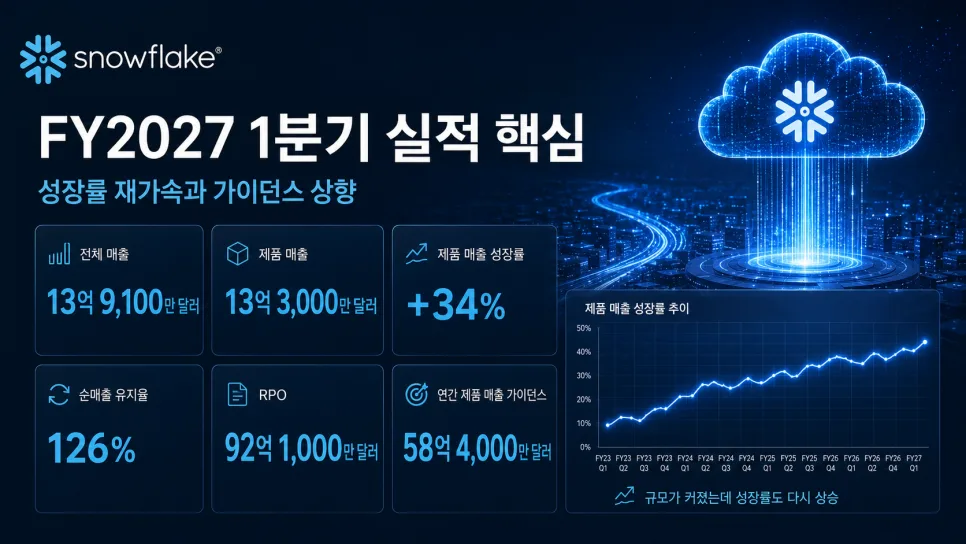
In fiscal 2027 Q1, total revenue was $1.391 billion, up about 33% from $1.042 billion in the same quarter a year earlier.
The most important number, product revenue, rose 34% to $1.33 billion. What really matters here is that growth reaccelerated versus the back half of the prior fiscal year.
Net revenue retention was 126%. In plain English, existing customers are spending more with Snowflake than they were a year ago.
Remaining Performance Obligations, which reflect contracted future revenue, reached $9.21 billion, up 38% year over year. The fact that RPO is growing faster than current revenue is also a positive sign for future revenue visibility.
Snowflake also raised its full-year fiscal 2027 product revenue outlook to $5.84 billion, which implies about 31% growth year over year.
The pros and cons of the consumption-based model
If you are looking at Snowflake stock analysis, this is one of the most important things to understand: the company’s consumption-based revenue model.
A typical SaaS company collects a fixed monthly amount based on the number of seats a customer signs up for. Snowflake is different. Its actual revenue is much more directly tied to how heavily customers use data analytics and computing resources.
The upside is clear. As customers expand their data footprint and workloads, revenue can scale without requiring a major renegotiation every time. If AI usage keeps rising, data processing demand could rise sharply too.
The downside is just as real. If companies go into cost-cutting mode, they can optimize usage, and Snowflake’s revenue growth can slow down quickly. The company has already been through that before during periods of aggressive cloud cost optimization.
That is why, when evaluating SNOW, it is important to watch not just customer count but also usage trends among existing customers and net revenue retention.
AI is becoming a new growth engine
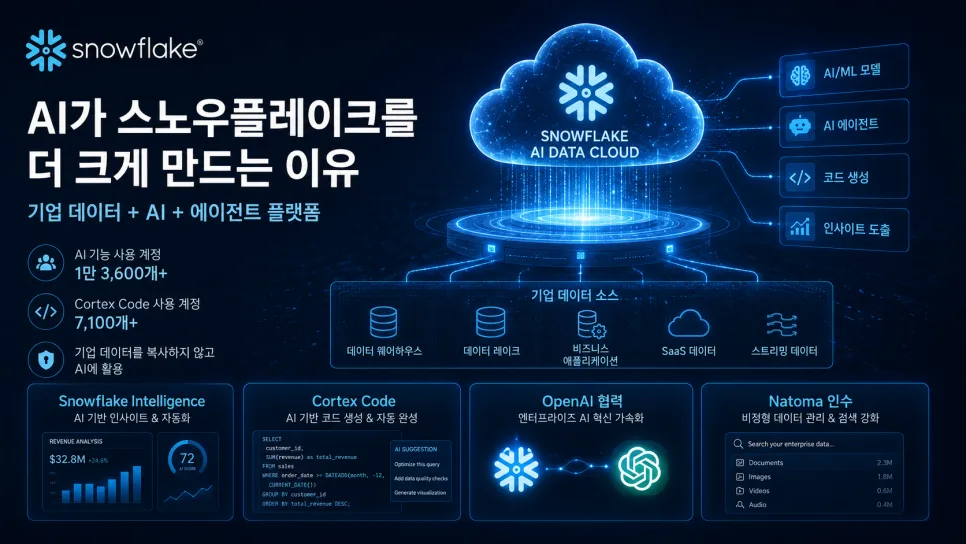
Right now, AI is the area Snowflake is pushing hardest.
One of Snowflake’s biggest advantages is that companies can use AI on data they already store and manage without having to copy that data over to another platform first.
Based on the average of the final four weeks of fiscal 2027 Q1, more than 13,600 accounts were using Snowflake AI features.
Cortex Code for developers was already being used by more than 7,100 accounts, and the number of accounts using Snowflake Intelligence for natural-language analysis of enterprise data more than doubled from the previous quarter.
The company also expanded its partnership with OpenAI. The goal is to let enterprise customers use the latest AI models inside the Snowflake data environment and build AI applications on top of their own data.
On top of that, in May 2026, Snowflake announced a deal to acquire Natoma, an MCP platform that securely connects AI agents to enterprise work tools.
The bigger picture is that Snowflake is trying to evolve from a simple data repository into a platform where enterprise AI agents can read data and actually get work done.
Large customers and contract sizes keep growing
If you want to judge Snowflake’s long-term growth potential, the number of large customers matters a lot.
As of the end of April 2026, Snowflake had 779 customers generating more than $1 million in product revenue over the trailing 12 months, up 29% from a year earlier.
Its number of Forbes Global 2000 customers also climbed to 813. Once a large enterprise starts putting data onto a core platform, there is a good chance usage expands into other departments and workflows.
In Q1 alone, Snowflake added 616 net new customers. That increase in new customers was up 38% from the same period last year.
In large enterprises, customers are not just using Snowflake for storage. They can also adopt analytics, data sharing, AI, and application development together, which makes the long-term value of each customer much higher.
Snowflake also signed a new $6 billion multiyear agreement with AWS. This is an important deal because it strengthens long-term cooperation around AI and data usage for enterprise customers running on AWS.
Profitability is improving, but stock-based compensation is still high
One of the biggest debate points around Snowflake is profitability.
In fiscal 2027 Q1, GAAP operating loss was about $326 million and net loss was about $296 million. So no, this is still not a GAAP-profitable company.
That said, the trend is improving. Operating loss in the same quarter last year was about $447 million, so the loss profile has improved meaningfully. GAAP operating margin also improved from negative 43% to around negative 23%.
On the other hand, stock-based compensation remains large. In Q1, stock-based compensation expense was about $402 million, or roughly 29% of quarterly revenue.
There is also about $3.8 billion in unrecognized stock compensation expense still to be recorded, which is expected to be recognized over an average of 2.9 years.
Better non-GAAP profitability and cash flow are definitely positives, but existing shareholders still need to keep an eye on dilution from stock-based compensation.
Snowflake had about $4.39 billion in cash plus short- and long-term investments at the end of April, so financially, the company still has plenty of flexibility.
The stock price and valuation have become expensive
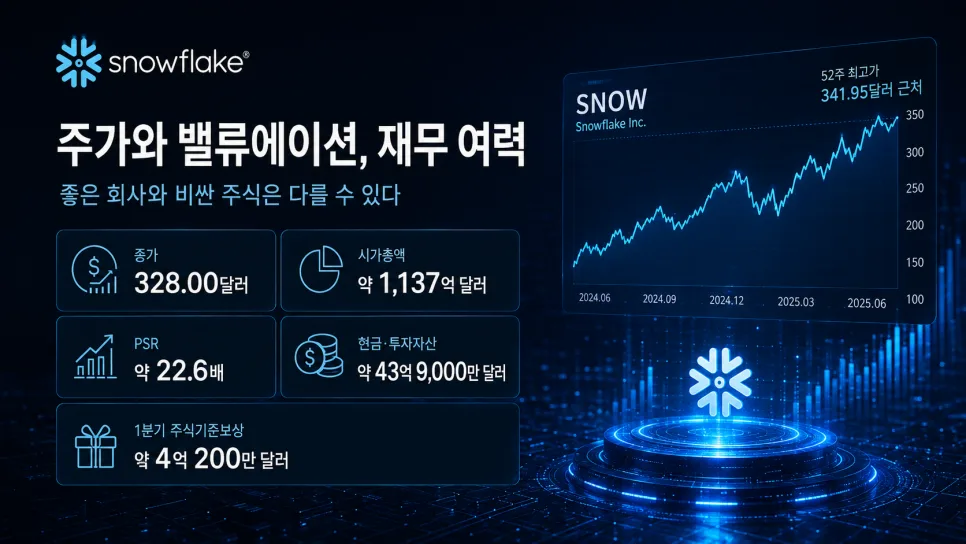
As of August 28, 2026, Snowflake closed at $328.00.
Its 52-week range is $118.30 to $341.95. The current price is only about 4% below the 52-week high, which tells you just how strong the recent rally has been.
Market cap is about $113.7 billion. With trailing 12-month revenue of about $5.03 billion, that puts the price-to-sales ratio at roughly 22.6x.
Forward P/E is also above 150x based on market estimates. Since Snowflake is still posting a GAAP net loss, it makes more sense to look at revenue growth, free cash flow, and non-GAAP margins alongside simple earnings multiples.
Even so, a valuation above 20 times sales is clearly rich. The market is pricing in continued growth around 30% and strong long-term operating margins.
Even if results stay solid, the stock could move much more sharply than the fundamentals if growth slips into the 20% range or AI-related revenue expansion falls short of expectations.
Pros and cons
Pros
• Fiscal 2027 Q1 product revenue growth reaccelerated to 34%.
• RPO increased 38%, showing strong growth in contracted future revenue.
• Net revenue retention of 126% shows existing customers are still expanding usage.
• More than 13,600 accounts are now using AI features, showing real customer adoption of AI.
• The number of $1 million-plus large customers rose 29%, showing continued enterprise penetration.
• Snowflake is expanding its AI data ecosystem through partnerships with major platforms including AWS, OpenAI, and SAP.
Cons
• The current valuation is high, with a price-to-sales ratio around 22x.
• On a GAAP basis, the company is still posting operating losses and net losses.
• Quarterly stock-based compensation is about $400 million, which creates meaningful dilution risk for shareholders.
• Because of the consumption-based model, results are sensitive to enterprise cloud cost-cutting.
• Competition is intense, not only from AWS, Microsoft, and Google, but also from data and AI platforms like Databricks.
• A lot of the AI growth story already appears to be priced into the stock, which raises the bar for future results.
The key numbers to watch in the next earnings report
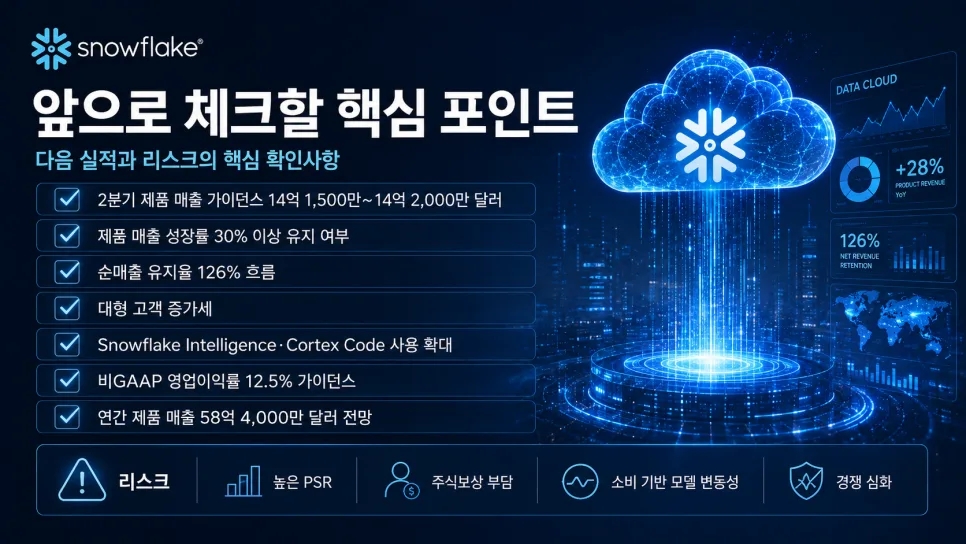
The biggest near-term event is fiscal 2027 second-quarter earnings. The official earnings release is scheduled for September 2, 2026.
The company is guiding for Q2 product revenue of $1.415 billion to $1.420 billion, which would represent roughly 30% year-over-year growth.
-
Whether product revenue guidance of $1.415 billion to $1.420 billion is achieved
-
Whether product revenue growth stays at 30% or higher
-
Whether net revenue retention holds at 126% or moves higher
-
Whether growth in $1 million-plus large customers continues
-
How much Snowflake Intelligence and Cortex Code account usage increases
-
Whether the company hits its 12.5% non-GAAP operating margin guidance
-
Whether full-year product revenue guidance of $5.84 billion is raised again
-
Whether GAAP operating loss margin and stock-based compensation continue to improve
This earnings report matters even more because the stock is already trading near its 52-week high. Beating the quarter may matter less than what management says about the road ahead.
Right now, the market is already pricing in a pretty high level of durable growth.
Final take
Looking at Snowflake again, it feels very different from the old version of the company that investors mostly saw as a cloud data warehouse play.
It started with data storage and analytics, but now it is expanding into a platform where companies can build AI on top of enterprise data and where AI agents can actually perform real work.
The numbers support that shift, at least to a meaningful degree. Product revenue grew 34%, RPO rose 38%, and the number of $1 million-plus customers increased 29%. For a company that is already this large, getting back to 30%-plus growth is a real strength.
The AI metrics also look good. More than 13,600 accounts are using AI features, and Cortex Code is already in use across more than 7,100 accounts. This is not just an AI story on a slide deck anymore.
But from a stock perspective, the risks are just as clear. At $328, the share price is sitting close to its 52-week high, and the price-to-sales ratio is around 22x. At this valuation, it is not enough to post good results. The company has to beat already-high expectations.
It is also hard to ignore quarterly stock-based compensation of more than $400 million. Non-GAAP results and cash flow look much better, but if you care about the economic value flowing to existing shareholders, you also have to look at GAAP results and dilution.
So my view is that Snowflake is one of the stronger AI data platform companies from a business-quality standpoint, but at the current price, execution matters more than ever.
In particular, if the September 2 Q2 report confirms 30% product revenue growth, another increase in full-year guidance, and continued expansion in AI usage, that would go a long way toward justifying today’s premium valuation.
On the other hand, if growth slows faster than expected, the stock could swing hard from here. At this point, the question is less whether Snowflake is a good company and more how much investors should be willing to pay for that quality.
Sources
• Snowflake fiscal 2027 Q1 earnings release
• Snowflake fiscal 2027 Q1 Form 10-Q
• Snowflake 2026 Investor Day materials
• Snowflake and OpenAI partnership announcement materials
• Snowflake and AWS multiyear partnership announcement materials
• Snowflake Natoma acquisition announcement materials
• Market data from StockAnalysis and Investing.com, as of August 28, 2026
#snowflake #SNOW #snowflake stock #SNOW stock #us stocks #us stock analysis #ai stocks #ai data #data cloud #cloud stocks #snowflake intelligence #cortex code #openai #aws #saas #us growth stocks #nyse #global stocks #stock investing #investing education