

At first glance, Toast sounds like just another restaurant POS company—the kind that handles orders and card payments. But today’s Toast looks much more like a full operating platform built for restaurants, connecting payments, ordering, delivery, payroll, inventory, customer management, lending, marketing, and AI in one ecosystem.
By Q2 2026, Toast had grown its connected locations to about 180,000, while annual recurring revenue, or ARR, climbed past $2.4 billion. Gross payment volume, or GPV, processed through the platform reached $60.7 billion in a single quarter.
Profitability is improving fast, too. Q2 revenue came in at $1.908 billion, up 23% year over year, while net income nearly doubled to $154 million. Adjusted EBITDA also rose to $221 million.
That’s why, when looking at Toast now, it matters less how many POS terminals it sells and more how effectively it can land one restaurant customer and then expand that account with software and financial services over time.
How Toast makes money
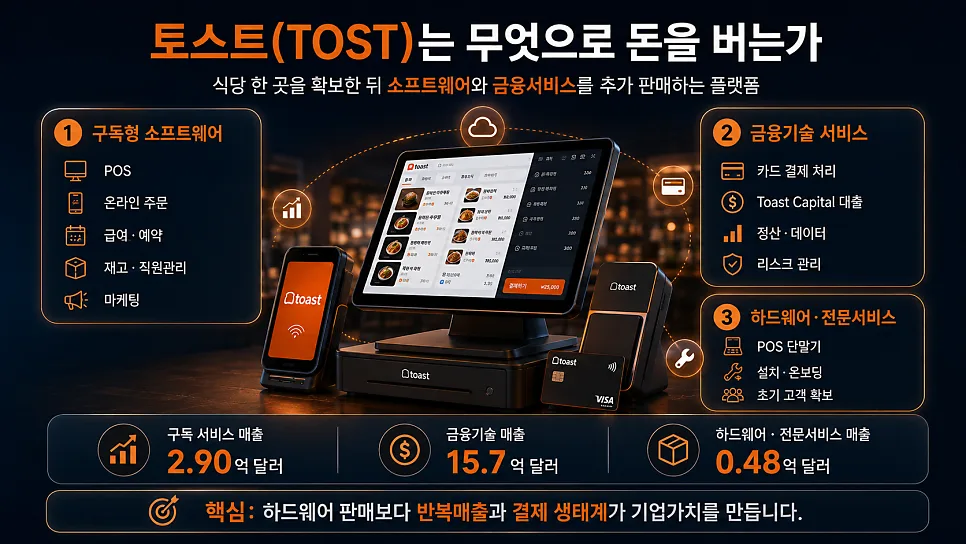
Toast’s revenue breaks down into three main buckets: subscription software, financial technology services, and hardware plus professional services.
Subscription revenue includes more than just POS software. It also covers online ordering, payroll, reservations, team management, inventory tools, marketing, and other restaurant operating software. In Q2 2026, subscription services revenue was $290 million.
The biggest revenue driver is Financial Technology Solutions. Every time a restaurant using Toast processes a card payment, Toast earns payment-related revenue. That segment generated $1.57 billion in Q2.
Hardware and professional services brought in about $48 million. Toast is clearly less focused on making big margins from the devices themselves and more focused on getting restaurants onto the platform first, then monetizing them over the long run through software and payments.
So when valuing Toast, total revenue matters—but recurring revenue and gross profit from subscriptions and payments matter even more.
Q2 2026 results were especially strong
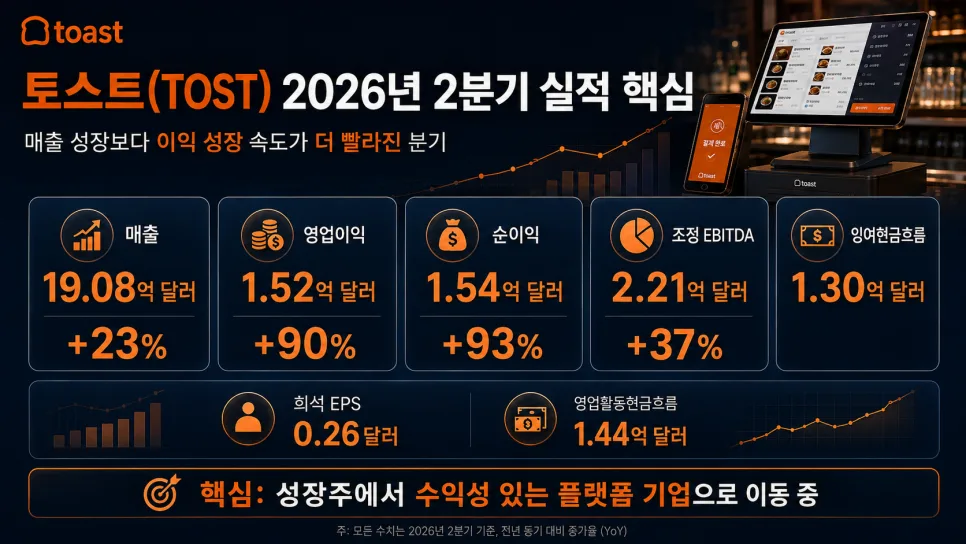
Total Q2 revenue was $1.908 billion, up about 23% from $1.55 billion in the same period last year.
Operating income increased from $80 million to $152 million, while net income rose from $80 million to $154 million.
Diluted EPS doubled exactly, from $0.13 to $0.26.
Adjusted EBITDA came in at $221 million. Compared with $161 million a year ago, that’s roughly 37% growth.
That said, the quarter included about $10 million in one-time gains tied to tariff refunds. It makes sense to back that out when judging the underlying profitability trend.
Q2 operating cash flow was $144 million, and free cash flow was $130 million.
The network of 180,000 restaurant locations is the core story
One of Toast’s most important operating metrics is Locations.
As of the end of June 2026, total Locations reached about 180,000, up 22% year over year. Toast added 9,500 net new locations in Q2 alone, marking the biggest quarterly increase in the company’s history.
ARR also rose 25% year over year to $2.4 billion.
GPV increased 22% to $60.7 billion. Since both GPV growth and location growth were 22%, payment volume per location was roughly flat compared with last year.
In other words, the current growth story is less about one restaurant suddenly doing dramatically more business and more about Toast continuing to add new restaurant locations at a rapid pace.
It also matters that once Toast gets into a restaurant, it can expand beyond POS into payroll, online ordering, marketing, reservations, and payments.
The company is getting better at making more money from each restaurant
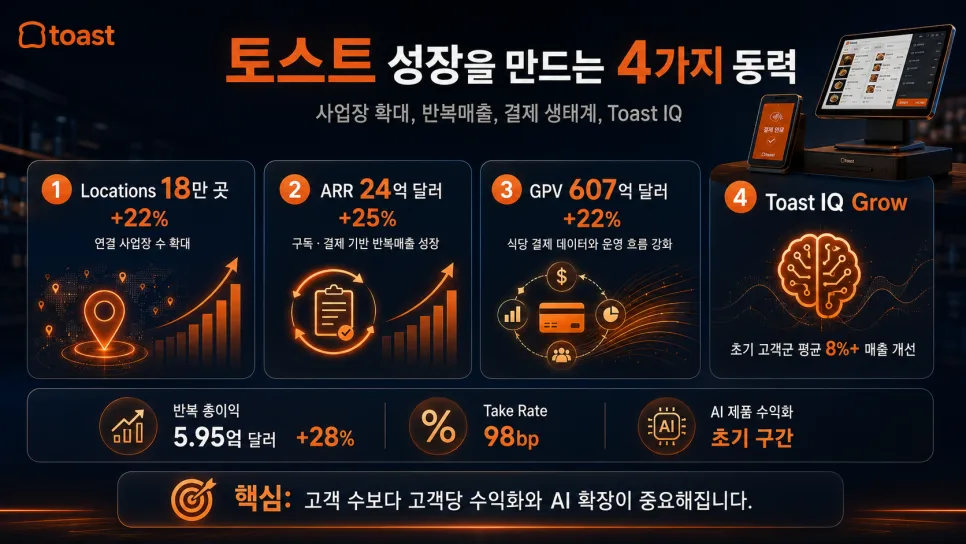
Non-GAAP subscription services and Financial Technology Solutions gross profit—a good measure of Toast’s recurring gross profit—reached $595 million in Q2.
That was up 28% year over year, faster than the 22% growth in Locations.
SaaS ARR grew 27% year over year, while payments ARR increased 23%.
Toast’s take rate, measured as recurring gross profit divided by GPV, also improved to 98 basis points, up 5 basis points from a year ago.
That suggests Toast is not only adding more restaurant customers, but also selling more paid software and financial services to its existing base.
Over the long run, it may matter even more whether ARR and recurring gross profit keep growing faster than Locations. That would be a strong sign that monetization per customer is still getting stronger.
Toast IQ is emerging as a new AI growth engine
Toast isn’t using AI just to automate customer support. It’s trying to use AI in ways that can directly help restaurants grow sales.
The clearest example is Toast IQ Grow. It’s an AI marketing product that analyzes restaurant sales data, identifies target customers, and automatically creates email, text, and ad campaigns.
According to the company, Toast IQ Grow is the fastest-growing new product Toast has launched so far and could become the fastest product in its history to reach $10 million in ARR.
In Toast’s early data, restaurants using Toast IQ Grow posted revenue that was on average more than 8% higher than comparable Toast restaurants.
One of Toast’s biggest AI advantages is that it already owns real restaurant POS data.
It knows what menu items sold, when they sold, which customers come back most often, and even which days are weak. That gives Toast a much more practical path to workflow automation than a generic AI tool would have.
If those AI agents eventually expand beyond marketing into payroll, staff scheduling, inventory, accounting, and bookkeeping, they could become a meaningful new driver of ARR per customer.
Toast is expanding beyond restaurants into hotels, retail, and international markets
Toast’s core market today is still U.S. restaurants, but the company is clearly widening its addressable market.
In 2026, BWH Hotels, which includes Best Western, officially added Toast as a POS option for hotels across North America. That opens up a new enterprise market in hotel restaurants and food-and-beverage operations.
Toast is also expanding its relationship with TGI Fridays by rolling out the Toast platform in U.K. locations.
In retail, the company is pushing into convenience stores, grocery stores, and liquor shops.
For now, these newer markets are still small compared with Toast’s overall business.
But management says ARR in these newer categories is growing faster than Toast’s restaurant business did back in its earlier growth phase, even though those markets are much larger in absolute size.
Long term, one of the biggest questions is whether Toast can break out of the “U.S. independent restaurant POS company” box.
Profitability is improving, but hardware costs still matter
One of the most encouraging changes at Toast is that profit growth is now outpacing revenue growth.
Q2 GAAP gross profit was $516 million, up about 32% from $392 million a year ago.
Operating income rose about 90%, from $80 million to $152 million over the same period.
On the other hand, hardware and professional services are still running at a loss. In Q2, that segment generated $48 million in revenue but had direct costs of $116 million.
That’s because Toast’s strategy is to place equipment at relatively low upfront pricing and recover the economics later through subscriptions and payments.
There’s nothing inherently wrong with that model, but the more aggressively Toast adds new Locations, the more upfront hardware costs and sales expenses can rise alongside it.
What really matters is how quickly the company can recover customer acquisition costs through future recurring revenue.
Share repurchases have started too
Toast is still a growth company, but it has also become more active with buybacks.
In the first half of 2026, the company repurchased about 19 million shares for $486 million.
Toast’s recent share count is about 578 million. For fast-growing tech companies, stock-based compensation often keeps pushing the share count higher, so buybacks can help offset some of that dilution.
At the end of June, Toast held about $1.015 billion in cash and roughly $698 million in marketable securities.
Still, this is not really a dividend story at this stage. It’s better viewed as a company using capital primarily for growth investment and share repurchases.
Current stock price and valuation
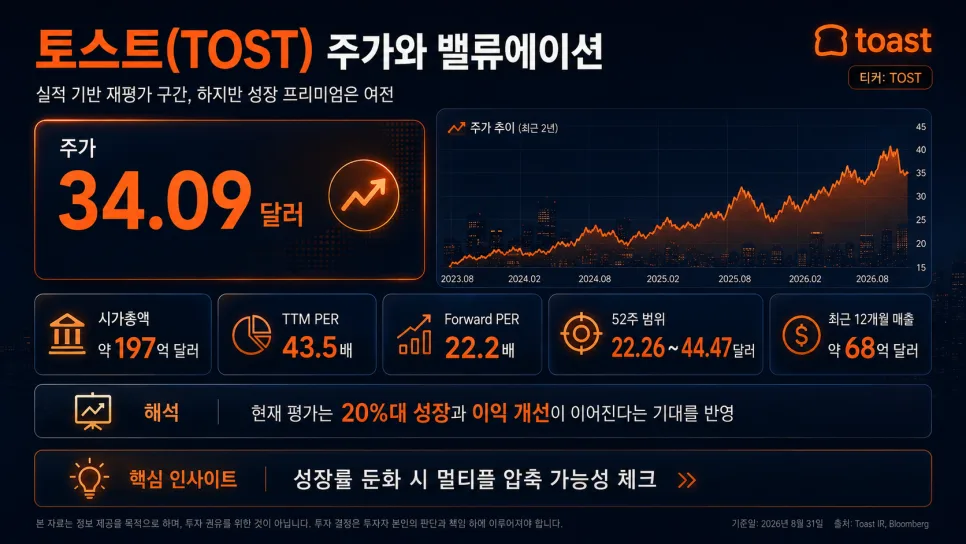
As of August 31, 2026, TOST closed at $34.09.
The 52-week range is $22.26 to $44.47. The stock has pulled back from recent highs, but it has recovered meaningfully from the May low.
Market cap is about $19.7 billion, and trailing 12-month revenue is roughly $6.8 billion.
TTM P/E is about 43.5x, and forward P/E is about 22.2x.
Based on current earnings alone, Toast still trades at a clear premium to traditional payment processors or financial companies.
On the other hand, with ARR and Locations both growing above 20% and net income nearly doubling, the valuation is easier to justify than it was back when the company was still losing money.
The real question starts here. The market already seems to be pricing in the idea that Toast can sustain recurring gross profit growth in the 20% range for quite a while.
If growth drops quickly into the teens, the stock could end up deserving a lower valuation than it has today.
Pros and cons
Pros
• Locations grew 22% to about 180,000, showing that the real customer base is still expanding quickly.
• ARR rose 25% to $2.4 billion, which points to strong recurring revenue growth.
• While revenue grew 23% in Q2, operating income and net income increased much faster.
• Toast IQ Grow could become a new revenue stream as Toast builds AI agents around restaurant data.
• By offering payments, subscriptions, lending, and marketing on one platform, Toast can keep increasing revenue per customer.
• The company is expanding beyond restaurants into hotels, international markets, and retail.
Cons
• At roughly 22x forward earnings, Toast still carries a growth premium versus simpler payment companies.
• GPV per Location was roughly flat year over year, which means a meaningful part of current growth still depends on adding new locations.
• Hardware and professional services are still unprofitable, so the cost of winning new customers remains high.
• If the restaurant industry slows down, both GPV and fintech revenue could come under pressure at the same time.
• Competition from Square, Clover, and other payment and POS providers is ongoing, and customer acquisition could get even more competitive.
• Investments in AI, international expansion, and retail may take longer than expected to translate into meaningful profits.
The key numbers to watch next quarter
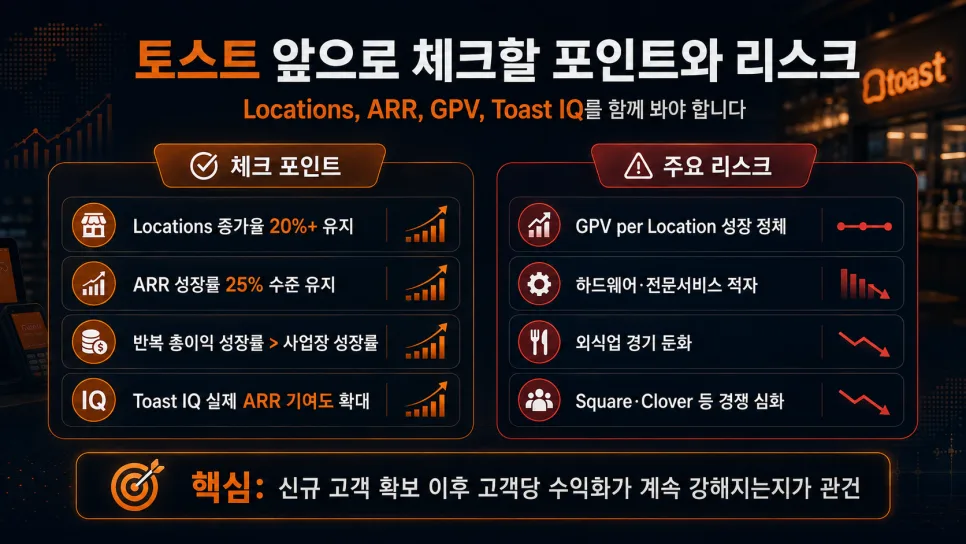
Toast is guiding for Q3 2026 non-GAAP subscription and fintech gross profit of $615 million to $625 million. That implies about 22% to 24% year-over-year growth.
Q3 adjusted EBITDA guidance is $210 million to $220 million.
The company also raised its full-year non-GAAP recurring gross profit outlook to $2.325 billion to $2.355 billion, or about 23% to 25% growth year over year.
Full-year adjusted EBITDA guidance is $805 million to $825 million.
In the next earnings report, these are the numbers I’ll check first:
-
Whether Locations growth stays above 20%
-
Whether ARR growth holds around 25%
-
Whether GPV per Location starts growing again
-
Whether recurring gross profit growth remains higher than Locations growth
-
Whether Toast IQ Grow and other AI products begin contributing more meaningfully to ARR
-
Whether growth in hotels, international markets, and retail stays strong
-
Whether hardware cost pressure starts easing
-
Whether adjusted EBITDA and GAAP operating margin continue improving
Final thoughts
The more I look at Toast, the more obvious it becomes that the company is much bigger than the first impression of a simple POS terminal maker.
Once Toast is installed in a restaurant, it can connect not just payments, but also ordering, delivery, payroll, team management, inventory, marketing, and even lending.
That structure is powerful because once Toast wins a customer, the number of products it can sell into that account keeps growing.
And the numbers back that up. Locations grew 22%, but ARR grew 25% and recurring gross profit grew 28%. This isn’t just customer growth—it’s rising economic value per customer too.
Profitability has improved a lot as well. Q2 net income rose from $80 million to $154 million year over year, and operating income nearly doubled too.
The AI angle is more interesting than I initially expected. Because Toast owns real restaurant order and customer data, Toast IQ has the potential to evolve beyond a simple chatbot into an AI agent that can directly drive revenue.
That said, I still think GPV per Location is worth watching closely. If customer additions start slowing, what matters more is how much existing restaurants can grow sales and how much Toast can keep increasing monetization per customer.
At $34.09, a forward P/E of about 22x is not obviously too expensive given the growth rate, but it’s also not the kind of valuation that gives the company much room for a major slowdown.
So from here, I’ll be watching more than just revenue. For this Toast stock review, the most important metrics are Locations, ARR, recurring gross profit growth, and the real monetization of Toast IQ Grow.
If those four metrics can keep compounding in the 20% range, I think Toast has a real chance to grow from a restaurant POS company into the operating system—and eventually the fintech and AI platform—for the restaurant industry.
Sources
• Toast Q2 2026 earnings release
• Toast Q2 2026 Form 10-Q
• Toast Q2 2026 prepared remarks and earnings call
• Toast Spring 2026 Release and official Toast IQ Grow materials
• Toast Investor Relations
• Market data from StockAnalysis and Investing.com, as of August 31, 2026
#toast #tost #toast stock #tost stock #us stocks #us stock analysis #fintech stocks #pos #payment stocks #saas #toast iq #toast iq grow #ai agents #restaurant tech #restaurant technology #us growth stocks #nyse #global stocks #investing #stock research #us stock investing