

If you still think of Coinbase as just a crypto exchange that makes more money when Bitcoin prices rise and trading fees spike, you’re only seeing about half the business today.
In 2026, the company’s biggest push is its Everything Exchange strategy. The idea is to bring crypto spot trading, derivatives, prediction markets, stablecoins, institutional services, custody, payments, and onchain developer infrastructure onto a single platform.
That shift is already starting to show up in the numbers. In Q2 2026, even though the broader crypto market wasn’t especially strong, Coinbase’s crypto trading volume market share hit a record 10.3%. At the same time, subscription and services revenue climbed to 48% of net revenue.
That said, this was not an easy quarter to call strong on headline results alone. Total revenue came in at about $1.22 billion, down from a year earlier, and net loss reached $359.5 million.
So when looking at COIN right now, the most important question is whether a company once heavily dependent on Bitcoin trading volume is truly becoming a business built on recurring financial infrastructure revenue.
How Coinbase makes money

Coinbase’s revenue base can be split into two big buckets: transaction revenue and subscription and services revenue.
Transaction revenue comes from retail and institutional customers buying and selling crypto, as well as trading derivatives and other financial products. The model is straightforward: when volatility rises and trading activity picks up, revenue tends to jump.
Subscription and services revenue, on the other hand, includes stablecoin revenue tied to USDC, staking and blockchain rewards, interest and finance income, custody, and other service lines.
Historically, Coinbase’s biggest weakness was simple: when crypto trading volume fell, revenue fell hard too.
But in Q2 2026, subscription and services revenue reached $555 million, or 48% of total net revenue. For context, that same business generated just $6 million in Q2 2020.
That’s one of the clearest signs that Coinbase’s transition from a pure exchange to a financial infrastructure company is starting to show up in real numbers.
How to read Coinbase’s Q2 2026 earnings

Net revenue for Q2 2026 came in at $1.154 billion. Including other revenue, total revenue was about $1.22 billion.
That was down from roughly $1.497 billion in total revenue during the same period last year. The biggest drag was weaker crypto prices and softer retail trading activity.
Transaction revenue was $599 million, down 22% year over year. Retail transaction revenue was hit especially hard, falling 31% to $452 million.
Institutional transaction revenue, however, rose 65% year over year to about $100 million. Retail trading conditions were weak, but Coinbase’s position in the institutional market actually improved, and that’s a meaningful positive.
Subscription and services revenue came in at $555 million, down 12% from a year earlier. Lower interest rates and weaker blockchain rewards were the main reasons.
Net loss was $359.5 million, while adjusted EBITDA was $207.8 million. Adjusted EBITDA stayed profitable for the 14th straight quarter.
In other words, this quarter looked weak if you focused only on revenue and GAAP profit, but it still showed progress in market share and business diversification.
Why the Everything Exchange strategy matters most

The Everything Exchange strategy is Coinbase’s attempt to move beyond the narrow definition of a crypto exchange.
The company is expanding from crypto spot trading into a broader platform that can offer derivatives, prediction markets, stablecoins, stocks, and more in one place.
In Q2 2026, Coinbase’s crypto trading volume market share reached a record 10.3%. That was up again from 9.1% in the prior quarter, marking a third straight quarter of record share.
Derivatives market share also hit a record high for the third consecutive quarter.
Prediction markets are growing especially fast. In Q2, both the number of prediction market contracts and related revenue rose 106% from the previous quarter, and annualized revenue moved past $100 million.
If Coinbase can generate revenue from derivatives and prediction markets even when crypto spot trading is weak, it could reduce the cyclical swings that have long defined the business.
USDC is becoming a real source of recurring revenue
One of the Coinbase businesses I’m watching most closely is USDC.
USDC is a stablecoin pegged to the U.S. dollar. It’s less of a speculative asset people buy hoping for price appreciation and more like a digital dollar that can be used for trading, payments, remittances, and onchain finance.
In Q2 2026, the average USDC balance held within Coinbase products reached a record $20 billion.
By the end of the quarter, more than 30% of total USDC in circulation was held within Coinbase products, and the company said it captured about half of the total USDC economic revenue over the past year.
Stablecoin revenue in Q2 was about $292 million. That was down roughly 5% year over year, largely because average interest rates fell even as USDC balances increased.
This is where the opportunity and the risk show up at the same time. If USDC usage keeps growing, Coinbase can build a larger recurring revenue base. But if rates fall, the revenue generated from the same balances can decline.
Even so, the fact that Coinbase is building a major revenue stream that isn’t directly tied to crypto prices is a very important change in the business model.
Base and x402 are starting to connect to AI finance infrastructure
Another area Coinbase has been emphasizing lately is Agentic Finance, where AI agents can make payments directly.
The idea is that instead of humans manually shopping online and checking out themselves, AI agents could increasingly find the data or services they need and automatically handle small payments on their own.
Base is the blockchain network where those transactions can happen, and x402 is the protocol designed to let AI and software make automatic payments across the internet.
According to the company, USDC was used in more than 99% of onchain AI agent commerce in Q2 2026.
More than 90% of AI agent stablecoin transaction volume happened on Base, and over 97% of onchain AI agent transactions used the Coinbase x402 protocol.
It’s still too early to say this contributes a major share of Coinbase revenue.
But if the market for AI agents making real payments online grows meaningfully, Coinbase could end up in a uniquely strong position because it already has USDC, Base, and x402 under the same umbrella.
You also have to watch the institutional, custody, and developer businesses
If you view Coinbase only as a retail crypto trading app, you risk missing the value of its institutional business.
The company offers Coinbase Prime for institutional investors, combining trading, custody, and financing services in one platform.
That matters because large institutions, including spot ETF players, need secure custody infrastructure if they want to hold crypto assets at scale.
As of the end of June 2026, total customer assets on the Coinbase platform were about $246 billion.
That was down significantly from a year earlier, largely because major crypto prices, including Bitcoin, had fallen. Even so, institutional transaction revenue increased 65% over the same period.
Through Coinbase Developer Platform, the company also lets businesses and developers plug wallets, payments, stablecoins, Base, and other onchain features into their own services.
Over the long run, if Coinbase wants to be valued as a financial infrastructure company, these institutional, developer, and payments businesses need to grow faster than consumer trading.
The stock and valuation are still highly volatile
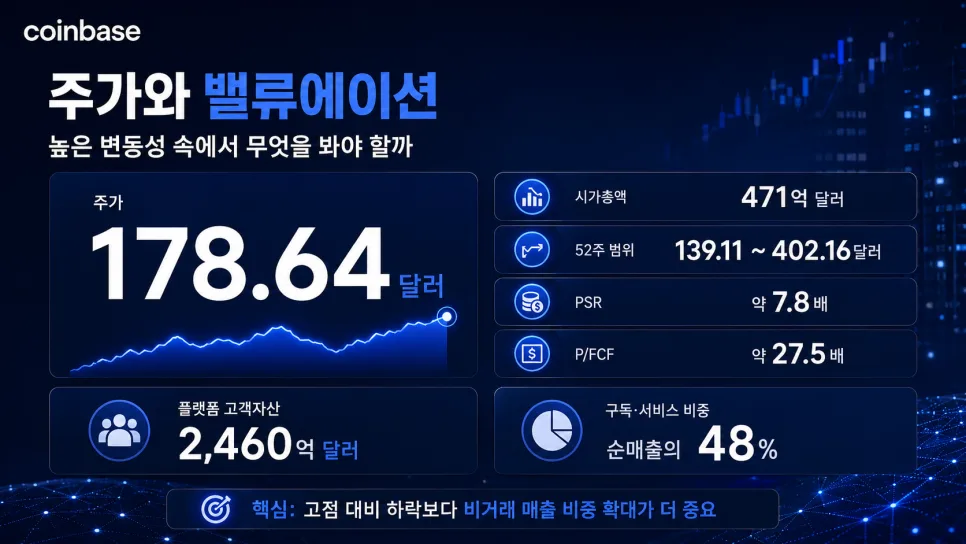
As of August 28, 2026, COIN closed at $178.64.
Its 52-week range is $139.11 to $402.16. The stock is down more than 50% from its high, but the bigger takeaway is just how wide the trading range still is.
Coinbase’s current market cap is about $47.1 billion.
Because the company is still in a net loss position over the last 12 months, a simple trailing P/E isn’t very useful. Even forward P/E based on market estimates is highly unstable and comes in above 150x.
Right now, it makes more sense to look at valuation through roughly 7.8x price-to-sales and about 27.5x price-to-free-cash-flow alongside the company’s growth rate.
The problem is that Coinbase’s results are still heavily influenced by crypto prices and trading activity.
The stock’s beta is also well above 3, which means if the crypto market gets shaky, COIN could move much more sharply than the broader market.
That’s why I think it matters less how far the stock has fallen from its peak and more how quickly non-transaction revenue is growing.
Pros and cons
Pros
• Crypto trading volume market share reached a record 10.3%.
• Subscription and services revenue rose to 48% of net revenue, reducing dependence on trading fees.
• Average USDC balances hit $20 billion, making stablecoins a major recurring revenue driver.
• The Everything Exchange strategy is starting to translate into real revenue as Coinbase expands into derivatives and prediction markets.
• Institutional transaction revenue rose 65% year over year, showing continued share gains in the institutional market.
• Base and x402 could give Coinbase an early-mover advantage in AI agent payments and onchain financial infrastructure.
Cons
• Q2 2026 total revenue and transaction revenue both declined year over year, reminding investors that the crypto cycle still matters.
• Coinbase posted a GAAP net loss of $359.5 million, highlighting ongoing earnings volatility.
• Customer assets remain highly sensitive to crypto price movements.
• Stablecoin revenue can become less profitable when interest rates fall.
• Regulatory changes around crypto, stablecoins, and prediction markets could materially affect the entire business.
• One counterparty accounted for 26% of total revenue in Q2, so revenue concentration with a specific partner is worth monitoring.
What to watch in the next earnings report

In Coinbase’s next earnings report, I’ll be watching business diversification more closely than Bitcoin’s price itself.
-
Whether crypto trading volume market share stays above 10%
-
Whether the decline in transaction revenue starts to stabilize
-
Whether subscription and services revenue moves above 50% of net revenue
-
Whether average USDC balances keep rising from the $20 billion level
-
How much stablecoin revenue can offset the impact of lower interest rates
-
How quickly prediction market annualized revenue grows beyond $100 million
-
Whether Base and x402 usage starts translating into meaningful revenue
-
Whether growth in institutional trading and custody remains intact
If subscription and services revenue eventually becomes larger than transaction revenue, the market may start valuing Coinbase very differently.
At that point, the case for seeing Coinbase not as a crypto exchange but as a financial infrastructure company with stablecoins, onchain payments, and institutional custody becomes much stronger.
Final thoughts
Looking at Coinbase again today, I do think the business model is clearly improving compared with the past.
Even in a quarter when crypto transaction revenue fell 22%, the company stayed profitable on an adjusted EBITDA basis, and trading volume market share still reached a record high.
The most important number, in my view, is that subscription and services revenue climbed to 48% of net revenue. That’s the clearest sign yet that Coinbase is moving away from a model built almost entirely on Bitcoin trading fees.
USDC is also especially interesting. Average balances reached $20 billion, and stablecoins are starting to connect not just to payments and remittances, but also to AI agent transactions.
Base and x402 are still early, but if a real market emerges where AI agents send and receive money directly, those assets could become a major point of differentiation for Coinbase versus other crypto exchanges.
On the flip side, COIN is still not an easy stock to own.
Crypto prices, trading volume, interest rates, and regulation all affect results at the same time. And the fact that Coinbase posted a net loss of more than $300 million in Q2 2026 should not be brushed aside.
So personally, I care less about guessing how high Bitcoin might go and more about how fast non-transaction revenue is growing at Coinbase.
If subscription and services revenue can sustainably stay above half of net revenue, and if USDC, institutional services, and Base keep expanding, Coinbase could evolve into a much higher-quality business than a typical crypto exchange.
If trading fees end up driving most of the results again, though, it will be hard to justify today’s financial infrastructure premium for very long.
Sources
• Coinbase Global Q2 2026 earnings release
• Coinbase Global Q2 2026 Form 10-Q
• Coinbase Q2 2026 Earnings Presentation
• Coinbase Investor Relations materials on Everything Exchange and USDC
• Official Coinbase materials on Base and x402
• StockAnalysis market data, as of August 28, 2026
#coinbase #Coinbase #COIN #coinbase stock #COIN stock #us stocks #us stock analysis #crypto stocks #bitcoin-related stocks #USDC #stablecoin #Base #x402 #AI agents #prediction markets #crypto exchange #us growth stocks #Nasdaq #international stocks #stock research #us stock investing